
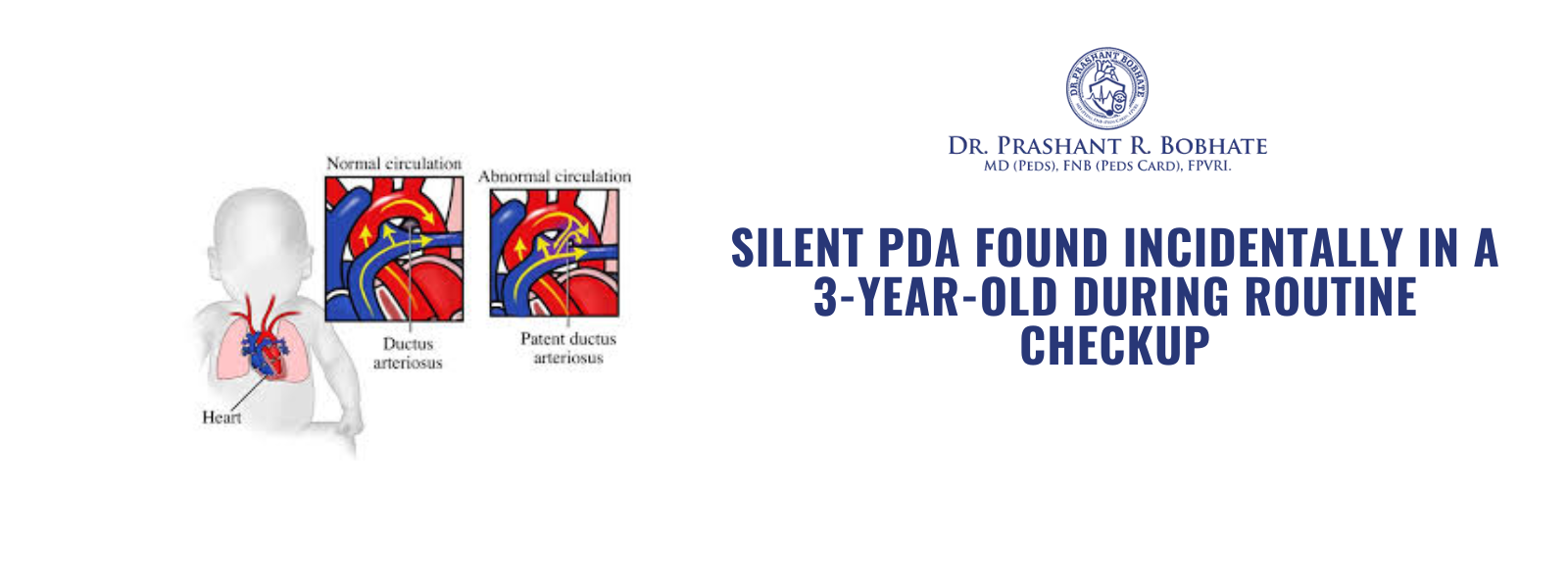
Silent PDA Found Incidentally in a 3-Year-Old During Routine Checkup
Patient Profile
Patient Name: Kabir S.
Age: 2 years
Gender: Male
Location: Thane, Maharashtra
Patient Background
Kabir was a quiet toddler. His parents thought that was just his personality.
He never ran around the way other two-year-olds did. Didn’t chase the dog. Didn’t throw tantrums at the park. He’d play for a few minutes, then sit down. His parents thought he was calm-natured. Introverted, maybe. His paediatrician said he looked fine.
But Kabir wasn’t fine.
He caught every cold going around. Each one hit harder than the last. His breathing was always a little fast. His lips sometimes looked faintly blue after a bath. He tired during meals. His weight sat at the bottom of the growth chart and stayed there.
It took fourteen months, two paediatricians, and one chest X-ray that showed an enlarged heart before anyone used the words pulmonary hypertension.
His parents drove straight to Mumbai. A family contact pointed them to a Child Cardiologist in Mumbai who ran a dedicated pulmonary hypertension clinic, the only one of its kind in Western India. That was Dr. Prashant Bobhate at Kokilaben Dhirubhai Ambani Hospital.
Symptoms
- Persistent fast breathing even at rest
- Tiring quickly during meals and play, would stop and sit after minimal activity
- Recurrent respiratory infections, each one taking longer to resolve
- Poor weight gain, consistently at the lowest percentile for age
- Occasional bluish tinge around lips after physical activity or bathing
- Low energy, far less active than other toddlers his age
Diagnostic Method
Given Kabir’s age and the complexity of the presentation, Dr. Bobhate ordered a stepwise diagnostic workup:
- 2D Echocardiography first-line test, showed elevated right heart pressures and an enlarged right ventricle
- Cardiac Catheterization gold standard for confirming pulmonary hypertension, directly measured pulmonary artery pressure and calculated pulmonary vascular resistance
- Chest X-Ray Review confirmed cardiomegaly (enlarged heart) noted on the referring hospital’s scan
- CT Pulmonary Angiography assessed lung vasculature and ruled out structural lung disease
- Blood Tests and Genetic Screening checked for connective tissue disorders and hereditary causes of PAH
- Pulmonary Function Tests evaluated lung capacity and airflow in relation to age norms
- Vasoreactivity Testing assessed whether Kabir’s pulmonary vessels could respond to vasodilator medications
Disease Diagnosed
Kabir was diagnosed with Pulmonary Arterial Hypertension idiopathic type, meaning no underlying structural heart defect or lung disease was found to explain it. His pulmonary vascular resistance was significantly elevated for his age. The right ventricle was already working under chronic strain.
In toddlers, idiopathic PAH is particularly difficult to catch early. The symptoms, fatigue, slow growth, fast breathing, overlap with far more common childhood illnesses. Most families spend months chasing the wrong diagnosis. By the time pulmonary hypertension is confirmed, the right heart has often already remodelled under the pressure load.
Kabir’s case was caught before irreversible damage had set in. That timing mattered enormously.
Treatment Plan
After reviewing the echocardiogram findings and discussing the case with the family, Dr. Prashant Bobhate recommended transcatheter device closure of the PDA. At three years of age and with a haemodynamically significant duct, waiting was not the right option.
Why Device Closure Was Recommended
- The PDA had not closed spontaneously in three years and showed no signs of doing so
- The left heart was carrying extra volume load, a strain that compounds quietly over years
- Leaving the PDA open beyond early childhood significantly raises the risk of developing pulmonary hypertension later
- Transcatheter device closure is a minimally invasive, same-day procedure in children Anaya’s age with no need for open surgery
- A catheter was guided through a small vein in the groin up to the heart under X-ray guidance
- A small plug device was deployed inside the ductus arteriosus, sealing it completely
- The entire procedure took under 60 minutes
- Anaya went home the following morning
No chest incision. No general surgical risk. No scar visible to anyone.
“A silent PDA is not a harmless PDA. It is a defect that has simply not announced itself yet. In a three-year-old with a haemodynamically significant shunt, closing it now is always better than waiting for symptoms to appear. Symptoms in this context mean damage has already been done.” — Dr. Prashant Bobhate, Pediatric Heart Specialist in Mumbai, Kokilaben Hospital
Post-Procedure Guidelines
Recovery after transcatheter PDA closure is straightforward but requires brief precautions:
- Keep the catheter entry site on the groin dry and clean for 48 hours
- Avoid bathing in a tub for the first week, stick to sponge baths
- No running, jumping, or rough play for two weeks
- Prescribed antiplatelet medication to be completed as directed
- Watch for any fever, unusual irritability, or swelling near the groin site
- Follow-up echocardiogram at one month to confirm complete closure
- Routine annual cardiac review for the first three years post-procedure
Outcome
Anaya went home the morning after the procedure, entirely unbothered.
She asked for her favourite snack in the car. Her parents were still processing what had happened.
At the one-month follow-up, the echocardiogram confirmed complete closure. No residual shunt. Left heart dimensions had returned fully to normal. The extra volume load was gone.
At six months, Anaya was reviewed again. Heart function was completely normal. No medications. No restrictions. She started nursery school that same month.
Her parents still talk about the routine checkup that found it. How close they came to never knowing.
Long-Term Expectations
With a completely closed PDA confirmed on echocardiography, Anaya is not expected to require any further cardiac intervention. Annual follow-ups will continue for three years as standard protocol, after which she will be discharged from cardiac care entirely if all remains normal. There are no long-term activity restrictions. She can play sport, swim, run, and live a completely unrestricted childhood.
What Anaya's Family Said
“We came in for a school checkup. We left with a heart diagnosis. It was terrifying for about 48 hours. Then Dr. Bobhate explained everything, showed us the echo, told us exactly what he was going to do. The next morning Anaya was asking for dosas. We are so grateful that murmur was caught when it was.” — Rekha R., Anaya’s Mother