
Written and medically reviewed by Dr Prashant Bobhate, MBBS, MD (Pediatrics), FNB (Pediatric Cardiology), Fellowship in Pulmonary Hypertension, University of Alberta, Canada. Registered with the Maharashtra Medical Council, Reg. No.2003/04/1714
Key takeaways
- A Potts shunt is a small connection made between the lung artery and the body’s main artery. It takes pressure off the right side of a child’s heart.
- It is used when pulmonary hypertension is severe, when lung pressure has risen above body pressure, and when medicines are no longer holding the condition.
- It is a palliative procedure, not a cure. What it offers is relief, better energy, and more time.
- It can be done by surgery, or in selected children through a thin tube, with no open operation.
- Published series report that children feel and function better soon after the procedure, with the right side of the heart working under far less strain.
- It is a high-risk procedure in very unwell children, and the decision is always made case by case, with the family fully involved.
If your child has severe pulmonary hypertension and you have been told that medicines are no longer working, this is one of the hardest places a family can be. You may have heard the words “transplant” or “no further options”, and come here looking for something else.
This guide explains what a Potts shunt is, which children it can help, what it can and cannot do, and how the decision is made. It is written to be honest rather than hopeful, because a decision this big deserves clear information. If you are at an earlier stage, our guide to pulmonary hypertension treatment covers the full range of care first.
What is a Potts shunt?
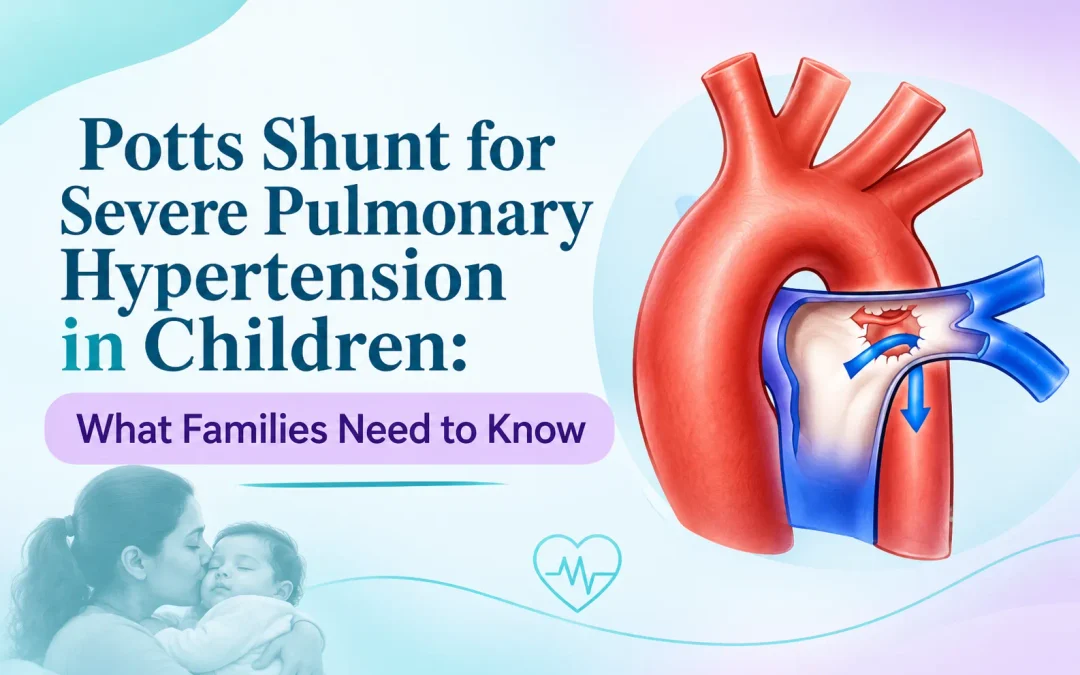
A Potts shunt is a connection created between the left pulmonary artery, which carries blood to the lungs, and the descending aorta, the main artery that supplies the lower body. In severe pulmonary hypertension, this connection lets some blood bypass the overloaded lungs, which eases the strain on the right side of the heart.
To understand why it helps, it helps to picture what pulmonary hypertension does to a child’s heart.
The right side of the heart is built for low pressure. Its job is to push blood gently into the lungs. In pulmonary hypertension, the lung arteries become narrow and stiff, so the right side has to push much harder. Over months and years, that chamber thickens, stretches, and begins to fail.
In the most severe cases, the pressure in the lungs rises higher than the pressure in the body. Doctors call this suprasystemic pulmonary hypertension. At this point the right side of the heart is working under more load than the left, which is the opposite of how a heart is designed to work.
A Potts shunt gives that pressure somewhere to go. By opening a controlled route from the lung artery to the aorta, it lets the right side of the heart offload. The pressure in the lungs and the body equalise, and the strained chamber gets relief.
The procedure is sometimes called a reverse Potts shunt, because the original operation, described in the 1940s, was used for a different purpose. In pulmonary hypertension, the flow runs the other way.
Which children can a Potts shunt help?
A Potts shunt is considered for children with severe pulmonary arterial hypertension whose lung pressure is higher than their body pressure, and whose condition is no longer controlled by medicines. It is usually discussed when the right side of the heart is beginning to fail, and when transplant is being considered or is not available.
In published series, the children who undergo this procedure share a clear pattern. They have suprasystemic pulmonary arterial hypertension despite being on maximum medical treatment, and the right side of the heart is deteriorating.
The usual criteria discussed are:
- Lung artery pressure higher than body pressure, confirmed on a cardiac catheter test
- Pulmonary arterial hypertension that has not responded to full medical therapy
- Signs that the right side of the heart is failing, such as fainting, severe breathlessness, or fluid retention
- A child who is waiting for a lung transplant, or for whom transplant is not a realistic option
The last point matters a great deal in India. Paediatric lung transplant is available in very few centres, waiting lists are long, and for many families it is not a practical path. A Potts shunt can offer something meaningful in that gap.
It is also important to say who it is not for. A Potts shunt is not used for mild or moderate pulmonary hypertension, and not for children whose pressures sit below body pressure. In those children, medicines and treating the underlying cause remain the right approach.
How does a Potts shunt help a child feel better?
By letting blood bypass the overloaded lungs, the shunt lowers the pressure the right side of the heart works against. Published series report that pressures equalise and right heart function improves within days, and that children show a clear improvement in what they can do.
The improvement families notice is usually practical rather than abstract. A child who could not climb stairs manages them. A child who had stopped playing starts again. One institutional series reported that the procedure lowers suprasystemic pulmonary hypertension to the systemic level, reduces the signs of right-sided heart failure, and improves how well children function day to day (institutional series, 2017).
A long-running French series of the first 24 children treated this way found that every child improved markedly in functional status immediately after either a surgical Potts shunt or stenting of the duct, and that this improvement held through to the last follow-up in all but two of them (Baruteau et al., 2015).
There is a trade-off, and families should understand it. The blood that bypasses the lungs carries less oxygen, and it travels to the lower half of the body. So oxygen levels in the legs and feet are lower than in the hands and face. Children adapt to this, much as children born with certain heart conditions do, but it is a real change and it is monitored carefully afterwards.
Surgical or transcatheter: what is the difference?
A surgical Potts shunt is created in an open operation. A transcatheter Potts shunt is made through a thin tube passed into a blood vessel, avoiding open surgery. Both achieve the same result. The choice depends on the child’s anatomy, age and condition.
| Comparison | Surgical Potts Shunt | Transcatheter Potts Shunt |
|---|---|---|
| How It Is Done | Open operation, usually with heart-lung bypass support. | Through a thin tube in a blood vessel, using a covered stent. |
| Recovery | Longer hospital stay. | Usually shorter recovery, with no surgical wound. |
| Best Suited To | Older or larger children, or those whose anatomy makes a catheter-based approach difficult. | Children with a suitable existing duct or favourable anatomy. |
| Durability | Published series suggest fewer repeat procedures over time. | May require repeat procedures more often. |
| Main Consideration | A bigger operation in a very unwell child. | Technically demanding and not possible in every child. |
Where a child still has a small natural connection from birth called a ductus arteriosus, the catheter route becomes simpler, because a stent can be placed through it. Where no such duct exists, the connection has to be created from scratch, which is technically harder.
Reviews of the published evidence note that the surgical Potts shunt tends to give longer-lasting results with less need for repeat procedures, which may make it the more reasonable option in older children (long-term outcomes review, 2022), though this remains an area where more research is needed. Your child’s team will weigh these factors individually.
Why does this matter so much for Indian children?
Pulmonary hypertension in Indian children looks different from the picture in Western textbooks, and that difference shapes who needs a procedure like this.
The PULMOEAST study, which analysed pulmonary hypertension patients at a tertiary centre in eastern India, found that the most common cause of PH was congenital heart disease, with shunt lesions making up 59.13% of cases, complex congenital heart disease 13.97%, and idiopathic PH 20.43% (PULMOEAST, 2023). In other words, most childhood pulmonary hypertension in India begins with a heart defect present from birth.
That matters because of timing. Many of these defects can be repaired with excellent results if they are found early. Left untreated, the lung arteries take permanent damage, and the pressure becomes fixed. The Pulmonary Hypertension Registry of Kerala was set up partly because India is likely to carry a large burden of PH, given the high prevalence of rheumatic heart disease, COPD and untreated congenital heart disease (PROKERALA registry), a pattern that differs from the West, where idiopathic PAH and left heart disease dominate.
The practical lesson for families is simple. Early referral prevents far more than any late procedure can repair. If you are reading this for a child who has only recently been diagnosed, our guide to pulmonary hypertension in children explains the earlier stages and what can still be done.
What are the risks of a Potts shunt?
A Potts shunt is a high-risk procedure, because the children who need it are already very unwell. Published series report serious complications, including deaths, particularly in children whose heart function is severely impaired before the procedure. It is offered only after careful assessment.
Being honest about this is part of helping families decide.
The main risks reported in the literature are:
- Problems in the period right after the procedure. When the shunt opens, the load on the left side of the heart changes suddenly. In children whose heart function is already poor on both sides, this can cause a serious drop in output. Published series describe this occurring, and in some cases proving fatal.
- Technical complications, including movement of the stent in catheter procedures.
- Need for repeat procedures, which published series report more often after catheter-based shunts.
- Lower oxygen levels in the lower body, which is expected rather than a complication, but needs monitoring.
A review of the published evidence notes that in-hospital deaths in the international Potts registry were linked specifically to catheter procedures done where no existing duct was present, compared with surgical shunts and duct-based catheter procedures (long-term outcomes review, 2022). This is one reason the choice between approaches is made so carefully.
The point of listing these is not to frighten anyone. It is that a family facing this decision deserves the real picture, including the possibility that the procedure may not go well.
Is a Potts shunt a cure for pulmonary hypertension?
No. A Potts shunt does not cure pulmonary hypertension and does not reverse the disease in the lung arteries. It is a palliative procedure, which means it relieves the effects of the condition rather than removing its cause.
What it offers is real, and worth naming clearly. It can relieve the strain on a failing right heart. It can restore energy and daily activity. It can delay the need for a transplant, and in some children it can remove the immediate need for one.
The underlying disease in the lung arteries continues, so medicines are usually carried on afterwards, and follow-up remains lifelong. A child who has had a Potts shunt still needs regular review of lung pressures, heart function and oxygen levels.
Importantly, a Potts shunt does not close the door on a transplant later. It is often described as a bridge, and for some children that is exactly what it becomes.
How is the decision made between a Potts shunt and a lung transplant?
The decision depends on how severe the child’s condition is, how the right side of the heart is functioning, the child’s age and size, and whether transplant is realistically available. In many Indian families, access to paediatric lung transplant is the deciding factor.
A comparison of the two from a paediatric centre found that children having a Potts shunt did better than transplant patients around the time of the procedure, with shorter time on a ventilator, a shorter hospital stay and a lower overall complication rate, while longer-term survival showed no significant difference between the two groups (midterm outcomes comparison). The authors concluded that the Potts shunt is an effective palliation for children with suprasystemic pulmonary hypertension, and one that may form part of a wider strategy to maximise both length and quality of life.
What this means in practice is that the two are not simply ranked against each other. For many children, a Potts shunt is the step that comes first, with transplant kept as a later option if it becomes necessary and available.
This conversation should always involve the family, the child where they are old enough, and a team that includes a paediatric cardiologist, a cardiac surgeon and intensive care specialists.
Is a Potts shunt performed in India?
Yes. The procedure is performed in a small number of specialist paediatric cardiac centres in India, including the Children’s Heart Centre at Kokilaben Dhirubhai Ambani Hospital, Mumbai, where both surgical and transcatheter approaches are available.
Dr Prashant Bobhate is a pediatric cardiologist and pulmonary hypertension specialist at the Children’s Heart Centre, Kokilaben Dhirubhai Ambani Hospital, Mumbai. He trained in pediatric cardiology at Escorts Heart Institute, New Delhi, and completed a fellowship in pulmonary hypertension at the University of Alberta, Canada. He has worked in pulmonary hypertension for more than 12 years, in both children and adults, and serves as Convenor in India for the Pulmonary Vascular Research Institute.
“Families usually come to us after being told there is nothing more to do. A Potts shunt does not cure the disease, and I say that plainly at the first meeting. What it can do is take the load off a failing right heart, and give a child their energy back. For a family who had stopped expecting good days, that is not a small thing.”
Dr Prashant Bobhate, Pediatric Cardiologist and Pulmonary Hypertension Specialist
Because the procedure is done in so few centres, children are often referred from other parts of India. Reports from your child’s existing team, including echocardiograms and any catheter study, can usually be reviewed before you travel.
What happens after a Potts shunt?
Children are monitored closely in intensive care in the first days, when the circulation adjusts to the new connection. Most then move to a ward, and go home once oxygen levels and heart function are stable. Medicines and lifelong follow-up continue afterwards.
Here is the general shape of recovery, though each child’s path differs:
- The first few days. Close monitoring in intensive care, as the heart adjusts to the changed pressures. This is the period of highest risk.
- The ward stay. Longer after surgery than after a catheter procedure. Oxygen levels in the upper and lower body are checked regularly.
- Going home. Families are taught what to watch for, including oxygen readings, breathlessness and changes in energy.
- Follow-up. Regular review with echocardiograms and, at times, repeat catheter studies. PAH medicines usually continue.
Many children return to school and to play. Activity levels are set individually, and your team will advise what is sensible for your child.
Related reads
- Pulmonary hypertension in children: signs, causes and treatment parents should know
- Interventional treatment for pulmonary hypertension
- Pulmonary hypertension treatment in Mumbai
References
- Baruteau AE, et al. Palliative Potts shunt for the treatment of children with drug-refractory pulmonary arterial hypertension: updated data from the first 24 patients. European Journal of Cardio-Thoracic Surgery, 2015. https://academic.oup.com/ejcts/article/47/3/e105/523590
- Long-term outcomes of transcatheter Potts shunt in children with suprasystemic pulmonary arterial hypertension. Frontiers in Cardiovascular Medicine, 2022. https://www.frontiersin.org/journals/cardiovascular-medicine/articles/10.3389/fcvm.2022.1028304/full
- Midterm outcomes of the Potts shunt for pediatric pulmonary hypertension, with comparison to lung transplant. https://profiles.wustl.edu/en/publications/midterm-outcomes-of-the-potts-shunt-for-pediatric-pulmonary-hyper/
- Singhi AK, et al. PULMOEAST: A Comprehensive Analysis of Pulmonary Hypertension in Eastern India. Cureus, 2023. https://www.ncbi.nlm.nih.gov/pmc/articles/PMC10780949/
- Pulmonary Hypertension Registry of Kerala (PROKERALA): rationale, design and methods. Indian Heart Journal, 2016. https://pmc.ncbi.nlm.nih.gov/articles/PMC5079135
About the author. Dr Prashant Bobhate is a Pediatric Cardiologist and Pulmonary Hypertension Specialist at the Children’s Heart Centre, Kokilaben Dhirubhai Ambani Hospital, Andheri West, Mumbai. He is Convenor in India for the Pulmonary Vascular Research Institute and head of its India Taskforce. Registered with the Maharashtra Medical Council, Reg. No. 2003/04/1714
Disclaimer: This article is for educational purposes and does not replace personal medical advice. Decisions about any procedure should be made with your child’s own specialist.
Consultations
Children’s Heart Centre, Kokilaben Dhirubhai Ambani Hospital, Andheri West, Mumbai
+91 80808 26898 | Book a consultation