
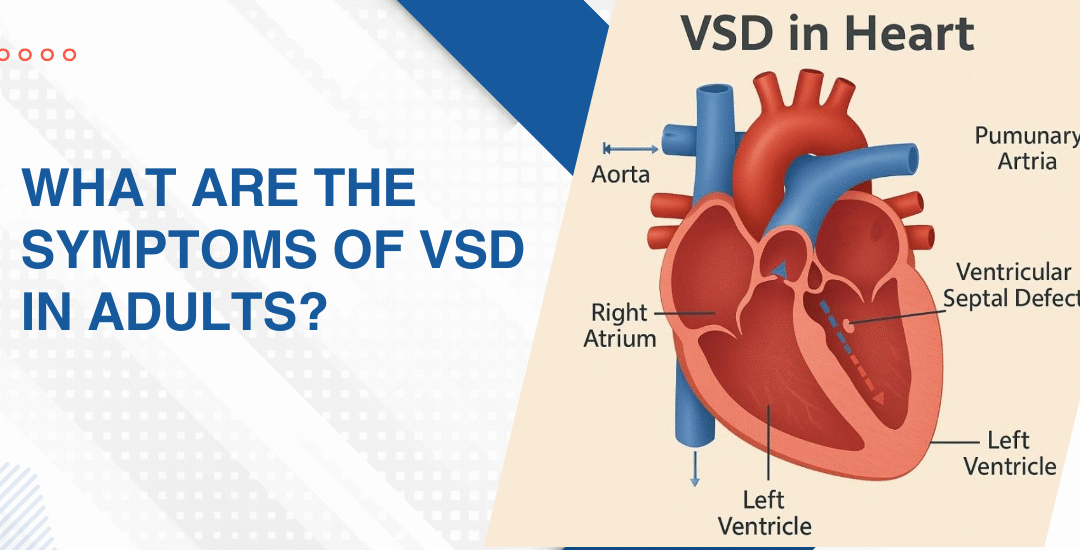
Adults with VSD most commonly experience breathlessness during exertion, fatigue that doesn’t improve with rest, heart palpitations and reduced exercise tolerance compared to people their age. Small VSDs often cause no symptoms at all and get found entirely by accident. Larger ones that were never repaired in childhood are the ones that eventually start making themselves known in ways that are hard to keep ignoring.
“A VSD in an adult isn’t always a childhood problem that was missed. Some are genuinely small enough to have caused nothing for decades and then one day the heart quietly tells you it’s been there all along,” says Dr. Prashant Bobhate, Pediatric Cardiologist in Mumbai, India.
What Physical Symptoms Does a VSD Cause in Adults?
Most adults with an unrepaired VSD spent years being told their murmur was innocent or that nothing needed doing. And for a small defect that’s often true. But a larger one that’s been quietly doing its thing for twenty or thirty years eventually starts showing up in how the body feels during ordinary life.
- Breathlessness on exertion: Getting winded doing things that shouldn’t wind you, stairs that were fine last year, walks that now feel harder than they should.
- Persistent fatigue: Not tiredness that sleep fixes but a baseline heaviness that sits there regardless of how much rest happens.
- Palpitations: The heart beating irregularly, racing unexpectedly or fluttering during activity or sometimes completely at rest without any obvious trigger.
- Reduced exercise tolerance: Noticing you can’t keep up the way you used to and quietly adjusting life around that limitation without ever really asking why.
These are exactly the symptoms that make getting the right ventricular septal defect assessment done properly matter rather than continuing to live around things that have a real explanation sitting right behind them.
What More Serious Symptoms Tell You Something Has Changed?
Because there’s a difference between a VSD that’s been stable for years and one that has started pushing the heart and the lungs into territory they were never meant to sustain long term. The symptoms in the second category aren’t subtle and they don’t wait politely.
- Cyanosis around lips or fingertips: Bluish discolouration means oxygen levels have dropped and that’s not something to observe for a few days before calling anyone.
- Swelling in the legs or ankles: Fluid accumulating in the lower limbs is the right heart telling you it’s struggling to keep up with what it’s being asked to do.
- Chest pain during activity: Any chest pain during exertion in someone with a known cardiac history is a same day assessment not a wait and see situation.
- Fainting or near fainting: Losing consciousness or nearly doing so during any level of activity means the heart isn’t maintaining adequate output under load and that needs investigating urgently.
Adults experiencing any of these symptoms and wanting to understand what the longer term picture of untreated pulmonary pressure looks like should read this piece on when is lung transplant necessary for pulmonary hypertension which explains honestly what happens when the pressure in the lung vessels has been elevated for too long without the right intervention.
Why Choose Dr. Prashant Bobhate for Balloon Valvuloplasty in Mumbai?
An adult presenting with VSD symptoms needs someone who understands both the congenital cardiac history and what decades of a shunt does to the pulmonary circulation over time. Dr. Prashant Bobhate spent over 12 years working specifically inside congenital heart disease from newborn diagnosis through childhood repair through adult follow up and late presentations. Trained at Escorts Heart Institute in New Delhi then went deliberately to the University of Alberta in Canada for advanced paediatric cardiac fellowship training. His team performed India’s very first successful Transcatheter Potts Shunt and actively manages over 400 children and young adults on advanced therapy right now. He doesn’t look at a murmur in isolation. He looks at what that murmur has been doing to the heart and lungs for every year it’s been there.
Schedule a consultation to find out if a cure is possible and what the right treatment plan looks like for you.
FAQs
Can a VSD cause symptoms for the first time in adulthood?
Yes especially if the defect was small enough in childhood to avoid detection but large enough to gradually strain the heart and lung circulation over decades.
Is VSD in adults dangerous?
A small stable VSD with no pressure changes or chamber enlargement is often managed safely with monitoring but a larger unrepaired defect causing pulmonary hypertension becomes genuinely serious over time.
Can a VSD be closed in adults?
Yes. Device closure or surgical repair is possible in adults if the pulmonary pressure hasn’t crossed into irreversible territory and a full cardiac assessment determines whether the window for intervention is still open.
What happens if a VSD in adults goes untreated?
A significant unrepaired VSD can eventually lead to Eisenmenger syndrome where lung vessel damage becomes permanent and the option for surgical repair closes entirely which is why timing of assessment matters.
References:
- Ventricular Septal Defect Overview, MedlinePlus, U.S. National Library of Medicine — https://medlineplus.gov/ency/article/001099.htm
- Congenital Heart Defects, National Heart Lung and Blood Institute — https://www.nhlbi.nih.gov/health/congenital-heart-defects