
Silent PDA Found Incidentally in a 3-Year-Old During Routine Checkup
Patient Profile
Patient Name: Anaya R.
Age: 3 years
Gender: Female
Location: Navi Mumbai, Maharashtra
Patient Background
Nobody expected to find anything wrong with Anaya.
She was a healthy, active three-year-old. Ate well. Slept well. Ran around the house all day. No breathing problems. No blue lips. No feeding trouble. Her parents brought her in for a routine pre-school health checkup. Nothing more than that.
The paediatrician listened to her chest and paused. Listened again. There was a sound that shouldn’t be there. A continuous murmur, like a machine humming. She referred the family to a specialist immediately.
That referral changed everything.
Anaya’s parents weren’t prepared for what came next. Their daughter looked completely fine. She felt completely fine. But the murmur pointed to something that needed attention before it caused damage that wouldn’t be so quiet.
They were referred to a Heart Doctor for Children in Mumbai with specific experience in structural heart defects in young children. That was Dr. Prashant Bobhate at Kokilaben Dhirubhai Ambani Hospital.
Symptoms
- No visible symptoms at the time of diagnosis
- Continuous machinery-like heart murmur detected on routine auscultation
- Mildly elevated heart rate on clinical examination
- Slightly increased respiratory rate noticed on closer evaluation
- No history of feeding difficulty, poor weight gain, or blue spells
Diagnostic Method
Because Anaya had no obvious symptoms, the diagnostic approach was methodical and non-invasive:
- Clinical Auscultation a continuous machinery murmur heard loudest below the left collarbone, classic presentation of PDA
- 2D Echocardiography confirmed a Patent Ductus Arteriosus with left-to-right shunting, assessed the size of the duct and the degree of volume overload on the left heart
- Colour Doppler Imaging mapped the direction and volume of blood flow across the PDA
- Chest X-Ray showed mildly increased pulmonary vascular markings, consistent with increased blood flow to the lungs
ECG showed left ventricular volume overload pattern, confirming haemodynamic significance of the defect
Disease Diagnosed
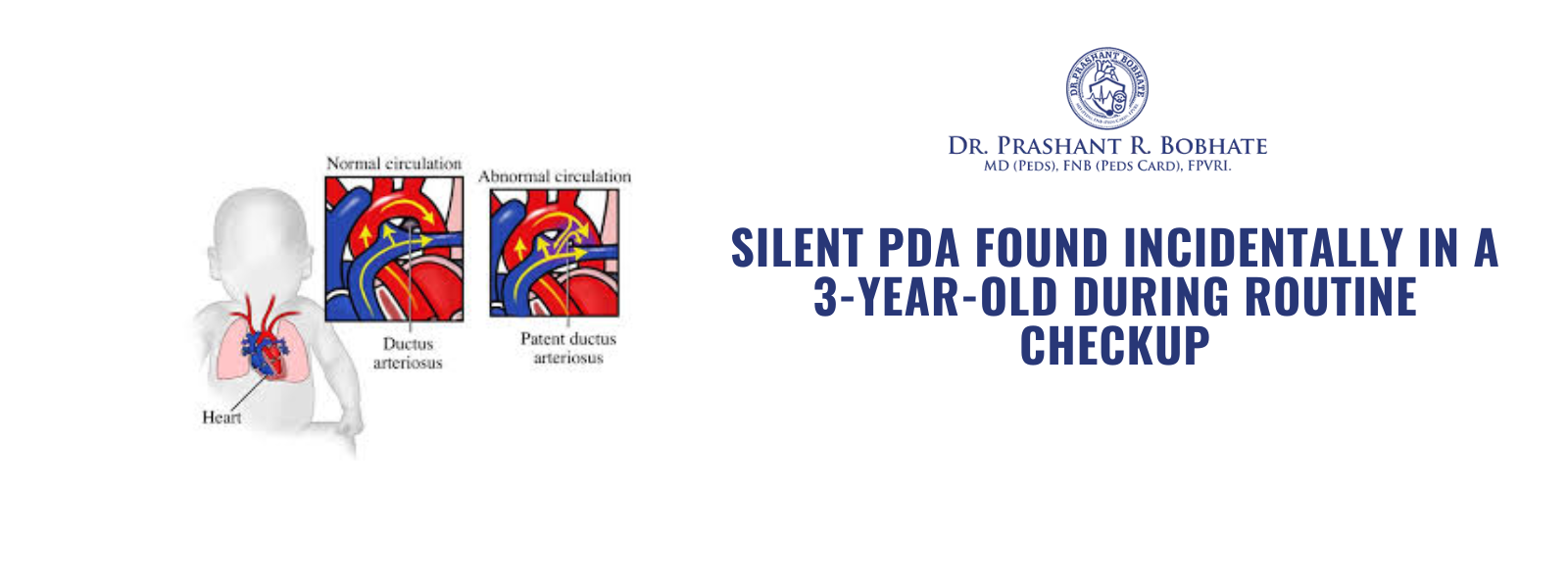
Anaya was diagnosed with a Patent Ductus Arteriosus (PDA), a blood vessel called the ductus arteriosus that connects the aorta and pulmonary artery during fetal life and is supposed to close within hours to days after birth. In Anaya’s case it had remained open for three years without causing any obvious symptoms.
This is called a silent or incidental PDA. The vessel was small enough not to cause breathlessness or feeding problems but large enough to cause a measurable volume load on the left side of the heart. Over time, even a small unclosed PDA increases the risk of pulmonary hypertension, infective endocarditis, and irreversible changes to the lung vasculature.
The fact that Anaya felt fine was not reassurance. It was a window of opportunity.
Treatment Plan
After reviewing the echocardiogram findings and discussing the case with the family, Dr. Prashant Bobhate recommended transcatheter device closure of the PDA. At three years of age and with a haemodynamically significant duct, waiting was not the right option.
Why Device Closure Was Recommended
- The PDA had not closed spontaneously in three years and showed no signs of doing so
- The left heart was carrying extra volume load, a strain that compounds quietly over years
- Leaving the PDA open beyond early childhood significantly raises the risk of developing pulmonary hypertension later
- Transcatheter device closure is a minimally invasive, same-day procedure in children Anaya’s age with no need for open surgery
- A catheter was guided through a small vein in the groin up to the heart under X-ray guidance
- A small plug device was deployed inside the ductus arteriosus, sealing it completely
- The entire procedure took under 60 minutes
- Anaya went home the following morning
No chest incision. No general surgical risk. No scar visible to anyone.
“A silent PDA is not a harmless PDA. It is a defect that has simply not announced itself yet. In a three-year-old with a haemodynamically significant shunt, closing it now is always better than waiting for symptoms to appear. Symptoms in this context mean damage has already been done.” — Dr. Prashant Bobhate, Pediatric Heart Specialist in Mumbai, Kokilaben Hospital
Post-Procedure Guidelines
Recovery after transcatheter PDA closure is straightforward but requires brief precautions:
- Keep the catheter entry site on the groin dry and clean for 48 hours
- Avoid bathing in a tub for the first week, stick to sponge baths
- No running, jumping, or rough play for two weeks
- Prescribed antiplatelet medication to be completed as directed
- Watch for any fever, unusual irritability, or swelling near the groin site
- Follow-up echocardiogram at one month to confirm complete closure
- Routine annual cardiac review for the first three years post-procedure
Outcome
Anaya went home the morning after the procedure, entirely unbothered.
She asked for her favourite snack in the car. Her parents were still processing what had happened.
At the one-month follow-up, the echocardiogram confirmed complete closure. No residual shunt. Left heart dimensions had returned fully to normal. The extra volume load was gone.
At six months, Anaya was reviewed again. Heart function was completely normal. No medications. No restrictions. She started nursery school that same month.
Her parents still talk about the routine checkup that found it. How close they came to never knowing.
Long-Term Expectations
With a completely closed PDA confirmed on echocardiography, Anaya is not expected to require any further cardiac intervention. Annual follow-ups will continue for three years as standard protocol, after which she will be discharged from cardiac care entirely if all remains normal. There are no long-term activity restrictions. She can play sport, swim, run, and live a completely unrestricted childhood.
What Anaya's Family Said
“We came in for a school checkup. We left with a heart diagnosis. It was terrifying for about 48 hours. Then Dr. Bobhate explained everything, showed us the echo, told us exactly what he was going to do. The next morning Anaya was asking for dosas. We are so grateful that murmur was caught when it was.” — Rekha R., Anaya’s Mother