
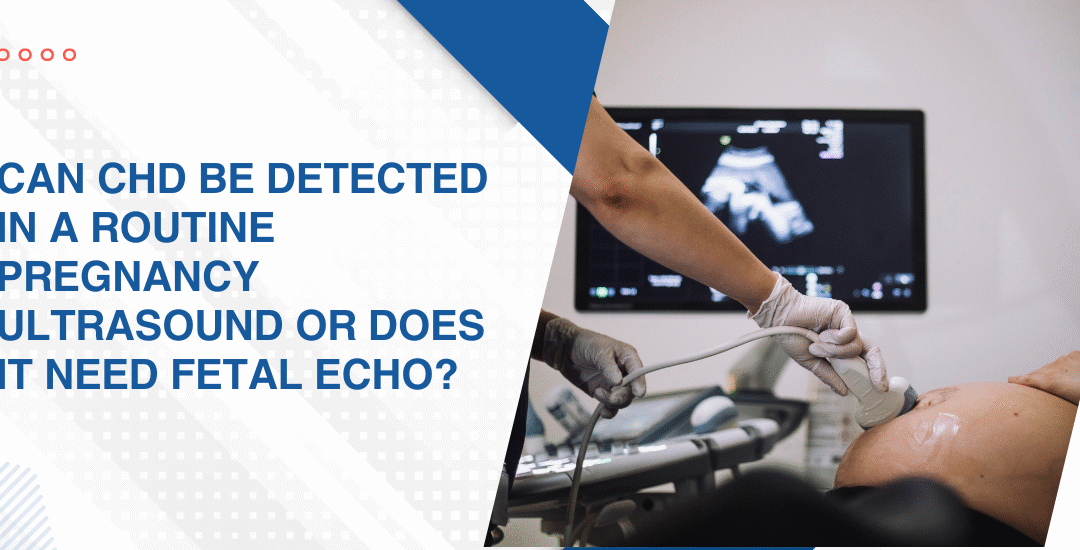
Congenital heart defects can often be suspected during a routine mid-trimester ultrasound between 18 and 22 weeks which includes a four-chamber heart view. However a specialised fetal echocardiogram is required for definitive detailed diagnosis because it is significantly more sensitive and specific for detecting complex cardiac abnormalities that the standard anomaly scan simply wasn’t designed to find.
“A normal anomaly scan is reassuring but it is not a cardiac clearance and families who come to me after a normal 20-week scan and a baby born with a significant defect are not rare. The anomaly scan looks at the heart. Fetal echo looks into it,” says Dr. Prashant Bobhate, Pediatric Cardiologist in Mumbai, India.
What Can a Routine Pregnancy Ultrasound Actually Detect?
The anomaly scan was designed to screen the whole fetus across multiple organ systems in a single appointment and cardiac assessment is one part of that broader sweep not the focus of it.
- Four-chamber view: The standard anomaly scan includes a four-chamber view that can identify major abnormalities in chamber size and symmetry but this single view misses outflow tract defects, valve abnormalities and many conotruncal anomalies that only become visible with additional dedicated cardiac views.
- Major structural defects: Large AVSDs, significant hypoplastic left heart and major ventricular asymmetry are visible on a well-performed anomaly scan in experienced hands but detection rates drop significantly in less specialised settings where cardiac views are obtained quickly as part of a broader structural survey.
- Operator dependence: The quality of cardiac screening on a routine ultrasound depends entirely on the operator’s training, the equipment available and the fetal position on the day and the same defect can be missed on one scan and flagged on another depending entirely on those variables.
- What it cannot show: Outflow tract abnormalities including TOF, transposition and pulmonary atresia, most valve defects, abnormal venous connections and many rhythm abnormalities simply cannot be reliably assessed on a routine anomaly scan regardless of how carefully it is performed.
Every pregnancy with a risk factor for congenital heart disease needs a dedicated fetal echocardiography assessment that goes well beyond what the anomaly scan was designed to provide.
When Is a Fetal Echo Specifically Needed?
Not just for high-risk pregnancies, fetal echocardiography is important for any pregnancy where the anomaly scan raises a concern
- Abnormal anomaly scan: Any cardiac finding flagged on routine ultrasound including an asymmetric four-chamber view, an unusual cardiac axis or a suspected outflow tract abnormality is an immediate indication for fetal echo by a specialist who does this regularly not occasionally.
- Family history of CHD: A parent or sibling with a congenital heart defect increases the recurrence risk to 3 to 5 percent and that risk is high enough to warrant fetal echo in every pregnancy in that family regardless of what the routine scan shows.
- Maternal conditions: Diabetes, systemic lupus, phenylketonuria and certain autoimmune conditions are associated with specific fetal cardiac abnormalities and mothers with these conditions need fetal echo as a standard part of antenatal care not an optional add-on decided case by case.
- Fetal arrhythmia on Doppler: A sustained irregular fetal heart rhythm picked up on routine Doppler needs fetal echo to characterise whether it’s a benign ectopic beat pattern or a sustained arrhythmia that requires monitoring or treatment before delivery.
Parents wanting to understand what fetal echo can and cannot detect and how findings change management before birth should read this piece on can a fetal echo detect baby heart defects because understanding the scope of the investigation is what allows families to ask the right questions at the right appointment.
Why Choose Dr. Prashant Bobhate for PH Management in Mumbai?
A fetal echo is only as useful as the person reading it and a specialist who performs fetal echos occasionally as part of a general obstetric practice reads the images very differently from one who has spent years specifically in fetal and paediatric cardiology managing the full spectrum of what those images reveal before birth and after. Dr. Prashant Bobhate has spent over 12 years performing fetal echocardiography and managing the post-natal cardiac outcomes of defects detected before birth at the Children’s Heart Centre, Kokilaben Dhirubhai Ambani Hospital. Escorts Heart Institute New Delhi.
Schedule a consultation to find out if a cure is possible and what the right treatment plan looks like for you.
FAQs
At what week should a fetal echo be done?
Between 18 and 24 weeks is the optimal window for most structural assessments though an experienced centre can obtain useful information from 16 weeks onwards and earlier scans may be indicated in specific high-risk situations.
Is fetal echo safe for the baby?
Yes completely because it uses the same ultrasound technology as a routine pregnancy scan with no radiation involved and no known risk to the fetus at the frequencies and durations used in clinical fetal cardiac assessment.
Can a fetal echo miss heart defects?
Some defects including small VSDs, mild valve abnormalities and some arrhythmias can be missed or only become apparent after birth which is why newborn cardiac assessment remains important even after a normal fetal echo.
Does a normal anomaly scan mean the baby's heart is definitely fine?
No because the anomaly scan is a structural survey not a cardiac assessment and a normal four-chamber view at 20 weeks does not exclude outflow tract defects, valve abnormalities or arrhythmias that fetal echo specifically looks for.
References:
- Fetal Echocardiography, MedlinePlus, U.S. National Library of Medicine — https://medlineplus.gov/ency/article/003791.htm
- Congenital Heart Defects, National Heart Lung and Blood Institute — https://www.nhlbi.nih.gov/health/congenital-heart-defects