Cardiopulmonary rehabilitation for PAH is a supervised programme of tailored exercise, monitoring, and education. It is not the same as a normal gym routine.
Current guidelines recommend it for people whose PAH is stable and who are already on the right medicines.
A specialist decides whether it is safe for you and how it should run. This is not something to begin on your own.
The clearest proven benefits are better walking ability and better quality of life. Rehabilitation is not a cure.
A programme can blend gentle aerobic activity, light strength work, breathing training, and education, built up slowly.
In India, expert guidance supports structured rehabilitation delivered in supervised, home, or hybrid forms, with low-cost additions such as supervised yoga.
If you live with pulmonary arterial hypertension (PAH), you may have been told to take it easy and avoid effort. For many years, that was the usual advice. It has changed.
Doctors now know that the right kind of exercise, done under supervision, can help many people with PAH feel better and do more. That planned programme is called cardiopulmonary rehabilitation for PAH. You may also see it described as pulmonary rehabilitation for PAH, or as pulmonary hypertension rehabilitation. This guide explains what it involves, who it suits, how it is kept safe, and what the evidence actually shows.
If you live with pulmonary arterial hypertension (PAH), you may have been told to take it easy and avoid effort. For many years, that was the usual advice. It has changed.
Doctors now know that the right kind of exercise, done under supervision, can help many people with PAH feel better and do more. That planned programme is called cardiopulmonary rehabilitation for PAH. You may also see it described as pulmonary rehabilitation for PAH, or as pulmonary hypertension rehabilitation. This guide explains what it involves, who it suits, how it is kept safe, and what the evidence actually shows.
What is cardiopulmonary rehabilitation for PAH?
Cardiopulmonary rehabilitation for PAH is a planned, medically supervised programme that uses tailored exercise, close monitoring, and patient education to improve how well you move and live each day.
Cardiopulmonary rehabilitation for pulmonary arterial hypertension is built around your condition, not around a general fitness goal. Some people need more gentle aerobic work, others need light strength training or breathing support. The starting point depends on your symptoms, your exercise capacity, your oxygen levels, your current treatment, and how stable your PAH is.
That is what sets it apart from joining a gym and following a standard plan. Trained staff set the level, watch how your body responds, and build up the effort only when it is safe.
One point matters above all. Rehabilitation is added to your medical treatment. It never replaces your PAH medicines. The2022 ESC/ERS guidelines recommend supervised exercise training for people with PAH who are already on medical therapy, as a strong (Class I, Level A) recommendation.
Why does pulmonary arterial hypertension make physical activity harder?
In PAH, the pressure is too high in the arteries that carry blood from the heart to the lungs. The right side of the heart then has to push harder to move blood through.
During activity, a healthy heart lifts its output to meet the extra demand. In PAH, that lift is limited. So you feel breathless and tired sooner than you expect. Some people also notice dizziness or chest discomfort when they push too hard.
These symptoms are uncomfortable, so it is natural to avoid the things that bring them on. Many people then do less and less. Over time, the body loses fitness, a change called deconditioning, and ordinary tasks feel harder still. The cycle looks like this:
PAH, then harder exertion, then less activity, then deconditioning, then even lower exercise capacity.
Rehabilitation is designed to break the functional side of that cycle. The aim is to rebuild stamina slowly and safely, while keeping exercise within a range your heart can handle.
Who is cardiopulmonary rehabilitation for, and when should it begin?
Guidance is clear on the main group it suits. Supervised exercise training for PAH is recommended for people whose condition is stable and who are already on medical therapy. Rehabilitation usually begins once the condition is clinically stable, not during a flare or a period of change. A pulmonary hypertension specialist judges whether it is right for you and how it should be delivered. The evidence is more limited for people with very severe disease, so the decision is always individual.
An assessment can be especially useful for people who have:
Reduced exercise capacity
Trouble with routine physical activity
Physical deconditioning
Breathlessness or fatigue during effort
Lost confidence with activity
In India, the picture is the same. The2026 PVRI India Taskforce consensus, led by Dr Prashant Bobhate, keeps supervised exercise training as a Class I, Level A recommendation for people with PAH who are stable on their medicines. In short, the Indian expert view matches the international one.
What assessments happen before PAH rehabilitation begins?
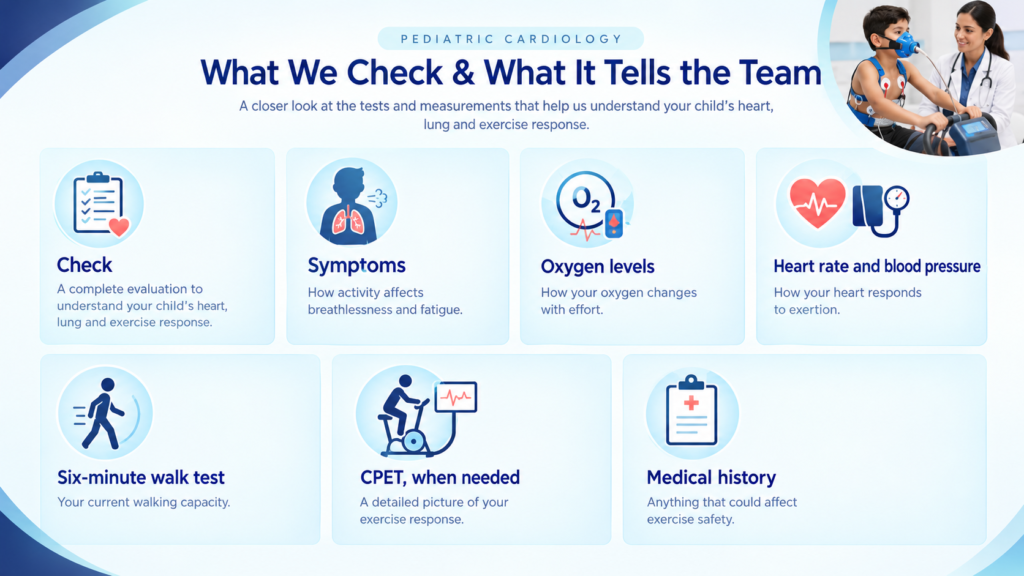
A good programme starts with a careful check, not with an exercise session. The team needs a clear picture of where you are before building a plan.
The team may review your medical history, your current PAH treatment, your symptoms, and other conditions that could affect safety. Two tests are used often.
The six-minute walk test
The six-minute walk test (6-minute walk test) measures how far you can walk in six minutes under set conditions. It gives a simple, reliable read on your current exercise capacity. It is usually repeated after a few weeks, so you and your team can see, in plain numbers, whether the programme is helping.
Cardiopulmonary exercise testing (CPET)
Cardiopulmonary exercise testing gives a more detailed look at how your heart, lungs, and muscles respond to effort. It may be used when the team needs to understand what is limiting you, and when the test is available.
Other checks that guide the plan
The team may also look at the factors below. Together, these set a safe starting point and a baseline to measure progress against.
What does a cardiopulmonary rehabilitation programme for PAH include?
A programme usually blends a few parts, each kept gentle and controlled. The exact mix depends on your assessment.
Aerobic activity
Aerobic exercise is the core. It builds stamina using activities such as walking, stationary cycling, stepping, or stair climbing. The2026 PVRI India consensus describes these same activities, at a moderate effort guided by how hard the work feels, in short sessions of around ten to fifteen minutes that are built up gradually over the weeks. Your team sets the exact level for you.
Light strength work
Strength training, also called resistance training, may be added for the main muscle groups, using controlled movements and a resistance level chosen for you. It matters because reduced activity can weaken muscles over time. The focus stays on steady breathing. Holding your breath or straining is avoided, because both can add sudden stress on the heart in PAH.
Breathing and inspiratory muscle training
Some programmes include training for the muscles you use to breathe. The India consensus lists this as a possible add-on alongside aerobic and strength work. It supports the rest of the plan rather than replacing it.
Warm-up, cool-down, and education
Each session usually opens with a gentle warm-up and closes with a cool-down, so your effort rises and falls slowly rather than in sudden jumps. Education runs through the whole programme. You learn to pace yourself, save energy for what matters, spot warning signs early, use oxygen correctly if it is prescribed, and know when to seek advice.
The Indian consensus adds a useful local touch here. It supports blending culturally relevant, low-cost options, such as supervised yoga-based breathing and movement, into standard programmes, which makes rehabilitation easier to keep up in Indian settings.
How is exercise monitored and kept safe during cardiopulmonary rehabilitation for PAH?
Monitoring is one of the main things that separates structured rehabilitation from ordinary exercise. It is how a programme stays safe.
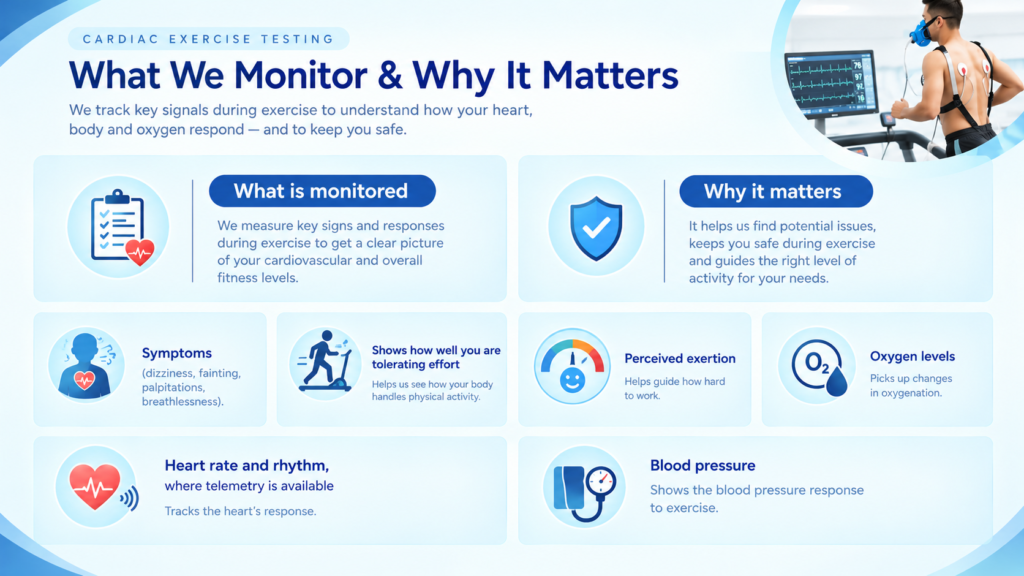
During sessions, the team keeps an eye on how you respond. The2026 PVRI India consensus sets out what to watch:
The point of monitoring is not to make you anxious about every number. It lets the team adjust the session when needed. The team also sets your targets. This is why you should not fix your own oxygen or heart-rate goals from a home device. Oxygen support, if you need it, is guided by your clinical team, not by a pulse oximeter reading alone.
What benefits does cardiopulmonary rehabilitation offer people with PAH, and what does the evidence show?
Research on exercise training in pulmonary arterial hypertension points to clear functional gains. The strongest evidence links rehabilitation to better exercise capacity and better quality of life, rather than to curing the disease.
In a large European trial of 116 people with PAH or a related condition called CTEPH, all already on medication, a supervised training programme improved the six-minute walking distance by about 34 metres more than usual care. The same study found better quality of life, better functional class, and higher peak oxygen uptake, and the programme was judged safe when run properly (Grünig et al., 2021).
Wider reviews that pool many studies point the same way, with average gains in walking distance often around 50 metres or more, and serious problems uncommon in stable, supervised patients (ERS statement). In day-to-day terms, that can mean walking further before you stop, managing stairs more easily, or getting through normal tasks with less breathlessness.
What the evidence does not show is just as important. Rehabilitation is not a cure. It does not reliably lower lung pressure for everyone, and it is not a reason to change or stop your PAH medicines. The honest promise is better function and quality of life, as one part of complete care.
When should someone with PAH pause or stop exercising?
Certain symptoms during exercise need attention straight away. If you are in a programme, your team will have told you what to watch for and what to do.
Stop or ease off, and get advice, if you develop:
Chest pain or discomfort
Fainting or near-fainting
Strong dizziness or lightheadedness
New or unusual palpitations
Breathlessness that is severe or clearly beyond the expected effort
Any other symptom your team has flagged for you
Your rehabilitation team also watches for signs that your heart is struggling or that your condition is changing. These warning signs are a key reason why starting under supervision matters so much in PAH.
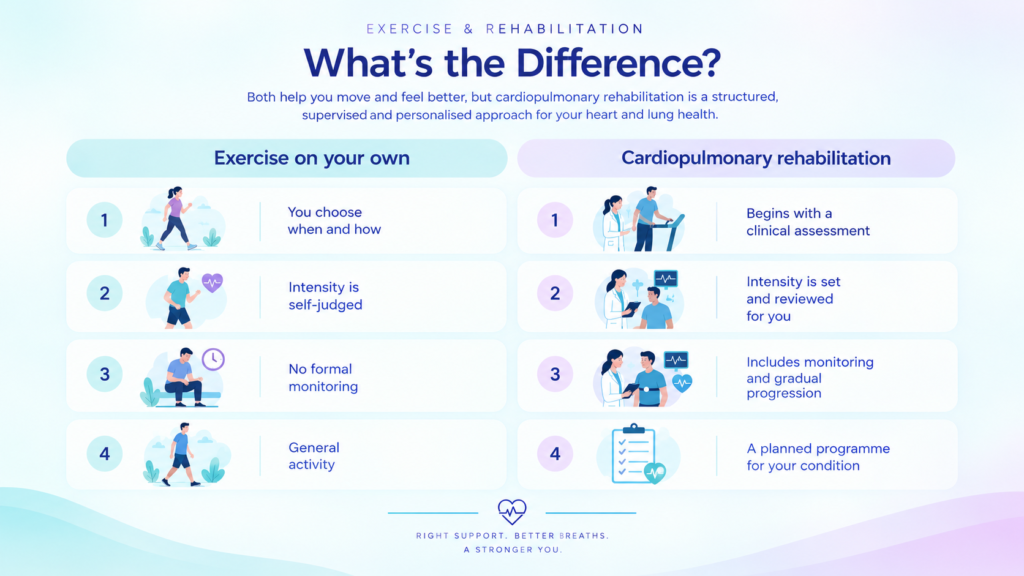
How is cardiopulmonary rehabilitation different from everyday exercise for PAH?
Everyday activity and cardiopulmonary rehabilitation overlap, but they are not the same thing. For someone with PAH, the difference is mostly about assessment, prescription, and monitoring.
Everyday exercise can be done on your own, fits around your daily life, and allows you to choose your own intensity. It often focuses on improving general fitness without clinical monitoring.
In contrast, cardiopulmonary rehabilitation begins with a clinical assessment and is tailored to your pulmonary arterial hypertension (PAH) and test results. Exercise intensity is set according to your individual needs, with the aim of safely improving your physical function. The program also includes clinical monitoring and gradual progression to support safe, effective exercise.
So the real question for someone with PAH is not whether exercise is good or bad. It is what type of activity suits you, at what level, and under what conditions. That guided, monitored approach is what makes exercise rehabilitation for PAH different from simply doing more.
Can cardiopulmonary rehabilitation for PAH continue at home?
Often, yes. Many people start under supervision and then carry on at home with a plan the team has set and keeps reviewing. The2026 PVRI India consensus recognises supervised, home-based, and hybrid models as valid ways to deliver rehabilitation, which helps people who live far from a centre.
The supervised start still matters. Home exercise works as a continuation of a monitored programme, not as a replacement for it. You keep to the targets your team set, watch for the same warning signs, and attend review visits so the plan can be checked and updated. If your symptoms change, the home part may need to pause while your specialist takes another look.
Speak to a pulmonary hypertension specialist before you start
Cardiopulmonary rehabilitation for PAH works best as one part of complete, specialist-led care. The right plan depends on your tests, your symptoms, and how your heart is coping, which is why the first step is always a proper assessment. At the Children’s Heart Centre, Kokilaben Dhirubhai Ambani Hospital in Mumbai, Dr Prashant Bobhate runs a dedicated, multidisciplinary pulmonary hypertension clinic, one of the first of its kind in Western India. If you or your child lives with PAH, talk to a pulmonary hypertension specialist about whether rehabilitation is suitable, and how to begin it safely.
Exercise for pulmonary arterial hypertension is no longer off-limits. The right activity, done safely, can help many people feel and function better.
It works best for people whose PAH is stable and who are on their medicines, with a specialist’s go-ahead.
Gentle aerobic activity such as walking, light strength work, and breathing exercises are the usual building blocks.
Keep the effort moderate. A simple guide is the talk test: you should be able to speak in short phrases, not sing, and not be gasping.
Avoid heavy lifting with breath-holding, high-intensity bursts, and exercising in extreme heat or at altitude.
Stop and seek advice for chest pain, fainting, strong dizziness, palpitations, or unusual breathlessness.
The question most people with PAH want answered is a practical one. What am I actually allowed to do? Can I still take the stairs, carry the shopping, or get back to some form of exercise?
Exercise for pulmonary arterial hypertension is safe and worthwhile for many people, but how you do it matters more than how much. The type of activity, the intensity, and knowing when to stop all have to fit your condition. This guide sets out which activities are safe, how to judge the right effort, what to avoid, and the warning signs to take seriously.
Can you exercise with pulmonary arterial hypertension?
People often ask, can you exercise with pulmonary hypertension safely? Yes, many people with PAH can exercise, as long as the plan is right for them and their condition is stable. Exercise is no longer treated as something to avoid.
Current guidance supports being active within your symptom limits (Royal Free NHS). The stronger evidence is for supervised exercise training in people who are already on medical treatment, which the2022 ESC/ERS guidelines now recommend as a Class I, Level A step.
Two conditions sit behind that “yes”. Your PAH should be stable, not in a flare, and you should already be on the right medicines. Safe exercise for pulmonary hypertension supports your treatment. It does not replace it. A pulmonary hypertension specialist should confirm that activity is right for you before you start.
What are the benefits of exercise for people with PAH?
The main benefits are better stamina, easier breathing during daily tasks, and a better quality of life. Exercise does not cure PAH, and it will not lower your lung pressure on its own, but it can help you do more with less effort.
The evidence is encouraging. In a large European trial of people with PAH and a related condition, a supervised training programme improved how far people could walk in six minutes by about 34 metres more than usual care, along with better quality of life and fitness (Grünig et al., 2021). Wider reviews point the same way, and serious problems are uncommon in stable, supervised patients (ERS statement).
In plain terms, that can mean climbing stairs more easily, walking further before you need to stop, and feeling steadier through a normal day. Set realistic goals. The aim is to feel and function better, not to train like an athlete.
Why does exercise for PAH need to be individualised?
There is no single workout that suits everyone with PAH, and no fixed set of exercise guidelines for PAH will fit every person. What is safe for one person can be too much for another, so exercise for pulmonary arterial hypertension has to be built around you.
Several things shape it: how severe your PAH is, your symptoms, your exercise tolerance in PAH, how far you can already walk, your oxygen levels, how your heart rate responds, your other health conditions, and your current treatment. A history of fainting or irregular heartbeats matters too.
This is why general fitness rules do not transfer well. A plan copied from a friend, a video, or a standard gym programme does not account for any of the above. Your specialist and, where possible, a trained physiotherapist set the starting level and decide how to build it up.
What types of exercise are safe for people with PAH?
What exercises are safe for pulmonary arterial hypertension? Most safe programmes mix a few simple parts. The aim is steady, gentle activity, not hard training.
Walking and gentle aerobic activity
Aerobic activity is the main building block. Good options include walking, stationary cycling, and swimming, all kept at an easy level and built up slowly. The2026 PVRI India consensus, led by Dr Prashant Bobhate, lists walking, cycling, stepping, and stair climbing as suitable aerobic choices, done at a moderate effort and increased gradually over the weeks. Regular physical activity with PAH is about frequency and consistency, not speed, so aerobic exercise for PAH works best little and often.
Light strength training
Light strength work, also called resistance training, can be added for the main muscle groups, using controlled movements and an easy resistance level. It helps because being less active can weaken muscles over time.
One rule matters here. Do not hold your breath or strain while lifting. People with PAH are advised to avoid this kind of straining, because it can trigger fainting (Valsalva study). The safe habit is to breathe out on the effort and keep breathing steady throughout.
Breathing exercises and gentle yoga
Breathing exercises for pulmonary hypertension can support the muscles you use to breathe. Gentle, low-impact movement such as yoga may also help. The Indian consensus supports adding supervised yoga-based breathing and movement to standard programmes, as a low-cost option that suits Indian settings. These are add-ons, not a replacement for aerobic activity or your medicines.
How hard should you exercise with PAH?
Keep it moderate. This is one of the most important parts of safe exercise with pulmonary arterial hypertension, and it is also where generic fitness advice goes wrong.
Ignore rules like “train at 70% of your maximum heart rate”. That kind of formula is not made for PAH. A better guide is how the effort feels. The2026 PVRI India consensus recommends a moderate intensity, judged by perceived exertion, in short sessions of around ten to fifteen minutes that are built up slowly.
A simple everyday check is the talk test. At a safe, moderate effort you should be able to speak in short phrases. If you can sing, you can probably do a little more. If you cannot get a few words out, you are working too hard and should ease off. Exercise intensity for PAH is personal, so your team may adjust this for you.
What should you watch while exercising with PAH?
Pay attention to how your body responds, not just to numbers on a device. Monitoring is a core part of safe exercise for pulmonary arterial hypertension, and of PAH exercise safety.
During activity, the things worth noticing are your symptoms, how breathless you feel, any dizziness, and how well you are coping overall. In supervised settings, the2026 PVRI India consensus also tracks oxygen levels, heart rate and rhythm where monitoring is available, blood pressure, and perceived exertion.
A word on gadgets. A home pulse oximeter can give useful information, but it does not replace your care team. Do not set your own oxygen targets from a reading, and do not use supplemental oxygen to push through harder sessions. Those decisions belong to your specialist.
What types of exercise should people with PAH avoid?
Some activities carry more risk and are best avoided unless your specialist says otherwise.
High-intensity interval training and anything that spikes your heart rate fast
Heavy weightlifting, especially with breath-holding or straining
Exercising to the point of exhaustion
Competitive or all-out effort that you cannot control
Exercising in extreme heat or at high altitude, where the air holds less oxygen
Any exercise on a day you feel unwell or more breathless than usual
This is not a simple list of “good” and “bad” exercises. The same activity can be fine at a gentle level and unsafe if pushed too hard. Supervised programmes sometimes use short bursts of easy activity with rest in between for people who cannot manage a long session, but that is planned and watched, not improvised. When in doubt, check with your team.
What warning signs mean you should stop exercising?
Stop the activity and get advice if any of these happen. These are the body’s signals that it is being pushed too far.
Chest pain or tightness
Fainting or feeling close to fainting
Strong dizziness or lightheadedness
A racing, pounding, or irregular heartbeat
Breathlessness that is severe or far beyond the normal effort
Any other symptom your care team has told you to watch for
If any of these appear, do not try to push through. Rest, and contact your specialist. Severe or lasting symptoms need urgent medical attention. These warning signs are the main reason it is safer to begin exercise with guidance rather than alone.
Is walking a good exercise for people with PAH?
Yes, walking is often one of the best starting points. It is easy to do, needs no equipment, and the pace and distance can be adjusted to how you feel on the day.
That said, walking with PAH still needs care. For anyone walking with pulmonary hypertension, the right pace, distance, and frequency depend on your symptoms and your stage of the disease. Start gently, build up slowly, and use the talk test to keep the effort moderate. If a route leaves you very breathless or dizzy, scale it back and mention it to your team.
Can people with PAH do strength training safely?
Yes, strength training with PAH can be safe when it is light, controlled, and done with the right breathing. The goal is to keep your muscles working, not to lift heavy.
Use an easy resistance, move in a slow and controlled way, and breathe out on the effort. The one thing to avoid is holding your breath or straining, which raises the risk of fainting in PAH. If a weight makes you grip, hold your breath, or clench, it is too heavy. Your team can set a safe level and show you the right technique.
How is exercise for PAH different from cardiopulmonary rehabilitation?
Everyday exercise and a formal programme overlap, but they are not the same. Rehabilitation is the structured, clinical version, built around assessment and monitoring.
If you want the full picture of the supervised, programme-based route, see our guide to cardiopulmonary rehabilitation for PAH. For many people, the two work together: a supervised start, then safe activity as part of daily life. The modern view of exercise and pulmonary arterial hypertension is not about avoidance, but about doing the right amount in the right way.
Make activity work for you
The honest summary is simple. For most people with stable PAH, the risk lies in the extremes, in doing nothing and losing fitness, or in pushing too hard and ignoring the warning signs. Safe exercise for pulmonary arterial hypertension sits between the two, and the sweet spot is different for every person.
That is why a short conversation with your specialist is worth more than any general plan. They can look at your symptoms, your tests, and your treatment, and tell you where your own limits sit and how to move them over time.
Dr Prashant Bobhate sees this regularly at the Children’s Heart Centre, Kokilaben Dhirubhai Ambani Hospital in Mumbai, which runs one of Western India’s first dedicated pulmonary hypertension clinics. If you or your child has PAH and wants to be more active, ask a pulmonary hypertension specialist what is safe for you, and build from there.
Disclaimer – This article is intended for educational purposes and does not replace individualised medical advice from a pulmonary hypertension specialist or rehabilitation professional.
COVID-19 is a contagious disease caused by the coronavirus SARS-CoV-2. In January 2020, the disease spread worldwide, resulting in the COVID-19 pandemic.
The symptoms of COVID‑19 can vary but often include fever,[7] fatigue, cough, breathing difficulties, loss of smell, and loss of taste.[8][9][10] Symptoms may begin one to fourteen days after exposure to the virus. At least a third of people who are infected do not develop noticeable symptoms.[11][12] Of those who develop symptoms noticeable enough to be classified as patients, most (81%) develop mild to moderate symptoms (up to mild pneumonia), while 14% develop severe symptoms (dyspnea, hypoxia, or more than 50% lung involvement on imaging), and 5% develop critical symptoms (respiratory failure, shock, or multiorgan dysfunction).[13] Older people have a higher risk of developing severe symptoms. Some complications result in death. Some people continue to experience a range of effects (long COVID) for months or years after infection, and damage to organs has been observed.[14] Multi-year studies on the long-term effects are ongoing.[15]
COVID‑19 transmission occurs when infectious particles are breathed in or come into contact with the eyes, nose, or mouth. The risk is highest when people are in close proximity, but small airborne particles containing the virus can remain suspended in the air and travel over longer distances, particularly indoors. Transmission can also occur when people touch their eyes, nose, or mouth after touching surfaces or objects that have been contaminated by the virus. People remain contagious for up to 20 days and can spread the virus even if they do not develop symptoms.[16]
Testing methods for COVID-19 to detect the virus’s nucleic acid include real-time reverse transcription polymerase chain reaction (RT‑PCR),[17][18] transcription-mediated amplification,[17][18][19] and reverse transcription loop-mediated isothermal amplification (RT‑LAMP)[17][18] from a nasopharyngeal swab.[20]
Several COVID-19 vaccines have been approved and distributed in various countries, many of which have initiated mass vaccination campaigns. Other preventive measures include physical or social distancing, quarantining, ventilation of indoor spaces, use of face masks or coverings in public, covering coughs and sneezes, hand washing, and keeping unwashed hands away from the face. While drugs have been developed to inhibit the virus, the primary treatment is still symptomatic, managing the disease through supportive care, isolation, and experimental measures.
PDA and VSD are both congenital heart defects that push extra blood into the lungs, but the location is completely different, a PDA is an open blood vessel sitting outside the heart that should have closed after birth, whereas a VSD is a hole inside the heart between the two lower chambers. The symptoms can look similar at first glance, the management timing and approach are not.
“Parents often hear ‘hole in the heart’ and assume PDA and VSD are the same thing. They aren’t. The anatomy is different, the natural history is different, and the treatment timing is different, which is why the distinction matters from the very first echo,” says Dr. Prashant Bobhate,Pediatric Cardiologist in Mumbai.
Where the two defects sit and why it matters?
A PDA is a leftover fetal vessel called the ductus arteriosus, it connects the aorta to the pulmonary artery and is meant to shut within the first few days of life. A VSD is a very different problem, a gap in the muscle wall between the right and left ventricles, sitting deep inside the heart and present from the time the heart formed in pregnancy.
PDA behaves like a loop outside the heart, blood leaks from the aorta into the pulmonary artery under constant pressure, which is why larger PDAs strain the lungs quickly
VSD behaves like an internal shortcut, blood skips from the left ventricle into the right, raising pressure and volume on the right side, and flooding the lungs over time
Symptoms overlap but the timing shifts, VSDs often show up with poor feeding and slow weight gain in infancy, PDAs can stay quiet for weeks before fast breathing and a murmur turn up
Closure happens at different sites, a PDA closes from outside the heart through a catheter threaded up a leg vessel, whereas a VSD usually needs a device placed inside the heart or open surgical patching
Getting the distinction right is the entire starting point, since the murmur character, the ECG pattern, and the echo findings all shift depending on which defect is present, which is why the broader overview on the congenital heart disease treatment page helps parents see where their child’s diagnosis fits in the bigger picture.
How treatment timing and options differ?
Both are treatable, the when and how is what separates them. A small PDA in a premature baby often closes on its own or with a short course of medication, larger PDAs in full-term infants get closed with a catheter-based device through the femoral vessels, usually a same-day procedure.
VSD size and location drive everything, small muscular VSDs often close on their own by age 2
Larger or high-pressure VSDs need device closure or open-heart surgery within the first year of life
Diuretics and heart failure medications buy time for small infants waiting for definitive treatment
Untreated large defects of either type eventually raise lung pressures, which is the outcome everyone is trying to avoid
For parents whose child has already been diagnosed with a PDA, the detailed walk-through onPDA management in Mumbai covers diagnosis, sizing, and device closure in more depth.
Why choose Dr. Prashant Bobhate?
Dr. Prashant Bobhate has over 12 years of experience managing PDA, VSD, and the full range of left-to-right shunt defects at the Children’s Heart Centre, Kokilaben Dhirubhai Ambani Hospital, with training in India and Canada that spans fetal echocardiography, catheter-based device closure, and surgical co-management for the defects that fall outside the catheter pathway.
Schedule a consultation to understand how PDA is Different from VSD in Babies
PDA and VSD can coexist in the same child, especially in premature infants or those with complex congenital heart disease. An echocardiogram confirms both and guides the order of treatment.
Which defect closes on its own more often?
Small muscular VSDs close spontaneously in a significant number of infants by age 2. A PDA in a full-term baby is less likely to close on its own after the first few weeks.
Is a VSD more serious than a PDA?
A large VSD generally causes more sustained lung pressure than a similar-sized PDA. Severity depends on the size and location of each defect rather than the type alone.
How are PDA and VSD detected in newborns?
Both are typically picked up by a heart murmur on routine examination and confirmed by echocardiography. Some cases are found antenatally on fetal echo.
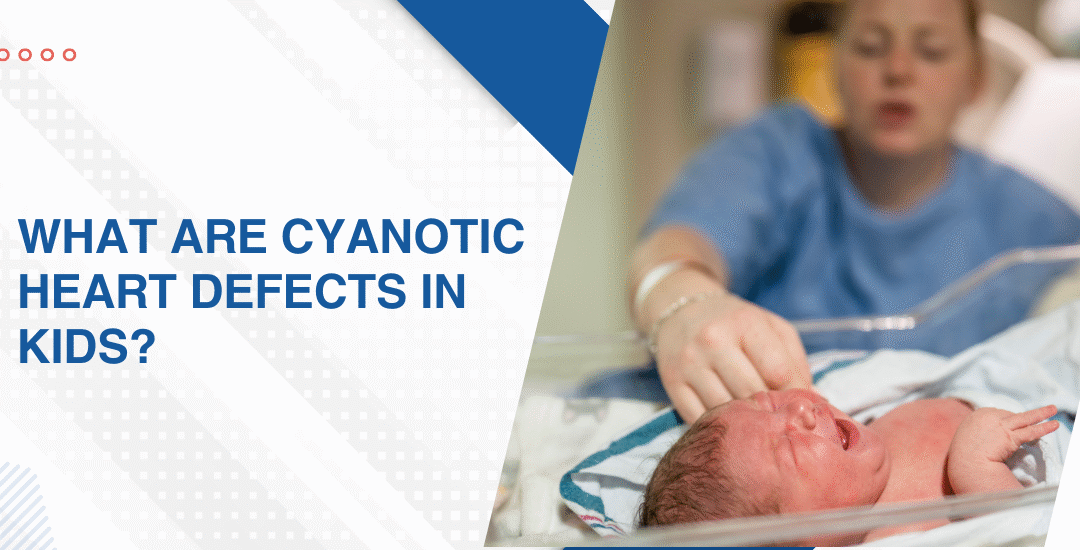
Cyanotic heart defects are congenital conditions where the heart’s plumbing pushes deoxygenated blood into the body instead of routing it through the lungs first, which is what gives affected babies the bluish tint on the lips, tongue, and fingertips. Most need surgical or catheter-based treatment inside the first year of life.
“The blue tint parents notice is never just about skin colour, it’s a sign the heart is routing deoxygenated blood into the body instead of the lungs. That’s why a cyanotic diagnosis triggers a fast work-up, we need to know which defect, how severe, and what the first intervention should be,” says Dr. Prashant Bobhate,Pediatric Cardiologist in Mumbai.
How cyanotic defects affect the body?
Blood flow in a healthy heart runs in a strict order, the right side sends used blood to the lungs for oxygen, and only after that does the left side pump it out to the rest of the body. Cyanotic defects break that order, sometimes by letting the two blood streams mix inside the heart, sometimes by blocking flow to the lungs outright, which is why saturations in these babies sit well below the 95% a healthy newborn holds.
Tetralogy of Fallot is the one we see most often, four problems bundled into one heart, a narrow pulmonary outflow, a VSD, an aorta straddling both ventricles, and a thickened right ventricle
Transposition flips the circulation, the aorta comes off the right ventricle and the pulmonary artery off the left, leaving the body and lung circuits running in parallel instead of in series
Tricuspid atresia blocks the right-side inflow, the valve simply never forms, so blood has to find an alternate route and that’s what the staged surgery ends up rebuilding
Anomalous pulmonary venous return sends oxygenated blood the wrong way, the pulmonary veins drain into the right side instead of the left, and the obstructed forms become a newborn emergency within hours
Pinning down the exact defect is what sets the plan, echocardiography maps the anatomy, saturations track severity, and the broader picture of how these conditions are diagnosed and managed is laid out on the congenital heart disease treatment page.
Signs, timing, and treatment pathways
Most of these defects show themselves inside the first few days, a blue baby with fast breathing and feeding difficulty is the classic presentation, though milder Tetralogy of Fallot can sit quietly until a tet spell hits, and severe transposition turns the baby deeply blue within minutes of delivery and needs stabilisation in the delivery room itself.
Pulse oximetry screening in the newborn nursery catches many of these defects before symptoms become obvious to the eye
Prostaglandin infusion is often the very first move, it holds the ductus open and keeps the circulation running until surgery can be planned
Almost all cyanotic defects are repaired or palliated in infancy, waiting is rarely an option for this group
Long-term outcomes have shifted dramatically, most children with repaired cyanotic CHD now reach adulthood and live active lives
For families working through a specific diagnosis, the detailed walk-through ontetralogy of Fallot management covers staged repair, timing, and long-term outlook for the most common cyanotic defect.
Why choose Dr. Prashant Bobhate for Cyanotic Heart Treatment?
Dr. Prashant Bobhate has over 12 years of experience managing the full cyanotic spectrum at the Children’s Heart Centre, Kokilaben Dhirubhai Ambani Hospital, from newborn stabilisation and catheter-based palliation through to definitive repair and adult follow-up, with training across India and Canada that covers TOF, transposition, single-ventricle physiology, and the rarer lesions families are less likely to have heard of before the diagnosis.
Schedule a consultation to understand how critical are Cyanotic Heart Defects In Children
How do I know if my baby's blue colour is a heart problem?
Blue colour limited to hands and feet in a warm baby is usually harmless. A bluish tint on the lips, tongue, or face needs urgent evaluation by a pediatric cardiologist.
Can a child with a cyanotic defect grow up normally?
Most children with repaired cyanotic defects attend school, play sport, and reach adulthood with a good quality of life. Lifelong cardiology follow-up remains essential.
Are cyanotic defects diagnosed before birth?
Many cyanotic defects are picked up on fetal echocardiography from 18 to 22 weeks of pregnancy. Fetal diagnosis allows delivery to be planned at a cardiac-equipped hospital.
What is pulse oximetry screening in newborns?
Pulse oximetry screening is a painless test that measures blood oxygen in the first 24 to 48 hours of life. It helps detect cyanotic defects before obvious symptoms appear.