
Key takeaways
- Exercise for pulmonary arterial hypertension is no longer off-limits. The right activity, done safely, can help many people feel and function better.
- It works best for people whose PAH is stable and who are on their medicines, with a specialist’s go-ahead.
- Gentle aerobic activity such as walking, light strength work, and breathing exercises are the usual building blocks.
- Keep the effort moderate. A simple guide is the talk test: you should be able to speak in short phrases, not sing, and not be gasping.
- Avoid heavy lifting with breath-holding, high-intensity bursts, and exercising in extreme heat or at altitude.
- Stop and seek advice for chest pain, fainting, strong dizziness, palpitations, or unusual breathlessness.
The question most people with PAH want answered is a practical one. What am I actually allowed to do? Can I still take the stairs, carry the shopping, or get back to some form of exercise?
Exercise for pulmonary arterial hypertension is safe and worthwhile for many people, but how you do it matters more than how much. The type of activity, the intensity, and knowing when to stop all have to fit your condition. This guide sets out which activities are safe, how to judge the right effort, what to avoid, and the warning signs to take seriously.
Can you exercise with pulmonary arterial hypertension?
People often ask, can you exercise with pulmonary hypertension safely? Yes, many people with PAH can exercise, as long as the plan is right for them and their condition is stable. Exercise is no longer treated as something to avoid.
Current guidance supports being active within your symptom limits (Royal Free NHS). The stronger evidence is for supervised exercise training in people who are already on medical treatment, which the 2022 ESC/ERS guidelines now recommend as a Class I, Level A step.
Two conditions sit behind that “yes”. Your PAH should be stable, not in a flare, and you should already be on the right medicines. Safe exercise for pulmonary hypertension supports your treatment. It does not replace it. A pulmonary hypertension specialist should confirm that activity is right for you before you start.
What are the benefits of exercise for people with PAH?
The main benefits are better stamina, easier breathing during daily tasks, and a better quality of life. Exercise does not cure PAH, and it will not lower your lung pressure on its own, but it can help you do more with less effort.
The evidence is encouraging. In a large European trial of people with PAH and a related condition, a supervised training programme improved how far people could walk in six minutes by about 34 metres more than usual care, along with better quality of life and fitness (Grünig et al., 2021). Wider reviews point the same way, and serious problems are uncommon in stable, supervised patients (ERS statement).
In plain terms, that can mean climbing stairs more easily, walking further before you need to stop, and feeling steadier through a normal day. Set realistic goals. The aim is to feel and function better, not to train like an athlete.
Why does exercise for PAH need to be individualised?
There is no single workout that suits everyone with PAH, and no fixed set of exercise guidelines for PAH will fit every person. What is safe for one person can be too much for another, so exercise for pulmonary arterial hypertension has to be built around you.
Several things shape it: how severe your PAH is, your symptoms, your exercise tolerance in PAH, how far you can already walk, your oxygen levels, how your heart rate responds, your other health conditions, and your current treatment. A history of fainting or irregular heartbeats matters too.
This is why general fitness rules do not transfer well. A plan copied from a friend, a video, or a standard gym programme does not account for any of the above. Your specialist and, where possible, a trained physiotherapist set the starting level and decide how to build it up.
What types of exercise are safe for people with PAH?
What exercises are safe for pulmonary arterial hypertension? Most safe programmes mix a few simple parts. The aim is steady, gentle activity, not hard training.
Walking and gentle aerobic activity
Aerobic activity is the main building block. Good options include walking, stationary cycling, and swimming, all kept at an easy level and built up slowly. The 2026 PVRI India consensus, led by Dr Prashant Bobhate, lists walking, cycling, stepping, and stair climbing as suitable aerobic choices, done at a moderate effort and increased gradually over the weeks. Regular physical activity with PAH is about frequency and consistency, not speed, so aerobic exercise for PAH works best little and often.
Light strength training
Light strength work, also called resistance training, can be added for the main muscle groups, using controlled movements and an easy resistance level. It helps because being less active can weaken muscles over time.
One rule matters here. Do not hold your breath or strain while lifting. People with PAH are advised to avoid this kind of straining, because it can trigger fainting (Valsalva study). The safe habit is to breathe out on the effort and keep breathing steady throughout.
Breathing exercises and gentle yoga
Breathing exercises for pulmonary hypertension can support the muscles you use to breathe. Gentle, low-impact movement such as yoga may also help. The Indian consensus supports adding supervised yoga-based breathing and movement to standard programmes, as a low-cost option that suits Indian settings. These are add-ons, not a replacement for aerobic activity or your medicines.
How hard should you exercise with PAH?
Keep it moderate. This is one of the most important parts of safe exercise with pulmonary arterial hypertension, and it is also where generic fitness advice goes wrong.
Ignore rules like “train at 70% of your maximum heart rate”. That kind of formula is not made for PAH. A better guide is how the effort feels. The 2026 PVRI India consensus recommends a moderate intensity, judged by perceived exertion, in short sessions of around ten to fifteen minutes that are built up slowly.
A simple everyday check is the talk test. At a safe, moderate effort you should be able to speak in short phrases. If you can sing, you can probably do a little more. If you cannot get a few words out, you are working too hard and should ease off. Exercise intensity for PAH is personal, so your team may adjust this for you.
What should you watch while exercising with PAH?
Pay attention to how your body responds, not just to numbers on a device. Monitoring is a core part of safe exercise for pulmonary arterial hypertension, and of PAH exercise safety.
During activity, the things worth noticing are your symptoms, how breathless you feel, any dizziness, and how well you are coping overall. In supervised settings, the 2026 PVRI India consensus also tracks oxygen levels, heart rate and rhythm where monitoring is available, blood pressure, and perceived exertion.
A word on gadgets. A home pulse oximeter can give useful information, but it does not replace your care team. Do not set your own oxygen targets from a reading, and do not use supplemental oxygen to push through harder sessions. Those decisions belong to your specialist.
What types of exercise should people with PAH avoid?
Some activities carry more risk and are best avoided unless your specialist says otherwise.
- High-intensity interval training and anything that spikes your heart rate fast
- Heavy weightlifting, especially with breath-holding or straining
- Exercising to the point of exhaustion
- Competitive or all-out effort that you cannot control
- Exercising in extreme heat or at high altitude, where the air holds less oxygen
- Any exercise on a day you feel unwell or more breathless than usual
This is not a simple list of “good” and “bad” exercises. The same activity can be fine at a gentle level and unsafe if pushed too hard. Supervised programmes sometimes use short bursts of easy activity with rest in between for people who cannot manage a long session, but that is planned and watched, not improvised. When in doubt, check with your team.
What warning signs mean you should stop exercising?
Stop the activity and get advice if any of these happen. These are the body’s signals that it is being pushed too far.
- Chest pain or tightness
- Fainting or feeling close to fainting
- Strong dizziness or lightheadedness
- A racing, pounding, or irregular heartbeat
- Breathlessness that is severe or far beyond the normal effort
- Any other symptom your care team has told you to watch for
If any of these appear, do not try to push through. Rest, and contact your specialist. Severe or lasting symptoms need urgent medical attention. These warning signs are the main reason it is safer to begin exercise with guidance rather than alone.
Is walking a good exercise for people with PAH?
Yes, walking is often one of the best starting points. It is easy to do, needs no equipment, and the pace and distance can be adjusted to how you feel on the day.
That said, walking with PAH still needs care. For anyone walking with pulmonary hypertension, the right pace, distance, and frequency depend on your symptoms and your stage of the disease. Start gently, build up slowly, and use the talk test to keep the effort moderate. If a route leaves you very breathless or dizzy, scale it back and mention it to your team.
Can people with PAH do strength training safely?
Yes, strength training with PAH can be safe when it is light, controlled, and done with the right breathing. The goal is to keep your muscles working, not to lift heavy.
Use an easy resistance, move in a slow and controlled way, and breathe out on the effort. The one thing to avoid is holding your breath or straining, which raises the risk of fainting in PAH. If a weight makes you grip, hold your breath, or clench, it is too heavy. Your team can set a safe level and show you the right technique.
How is exercise for PAH different from cardiopulmonary rehabilitation?
Everyday exercise and a formal programme overlap, but they are not the same. Rehabilitation is the structured, clinical version, built around assessment and monitoring.
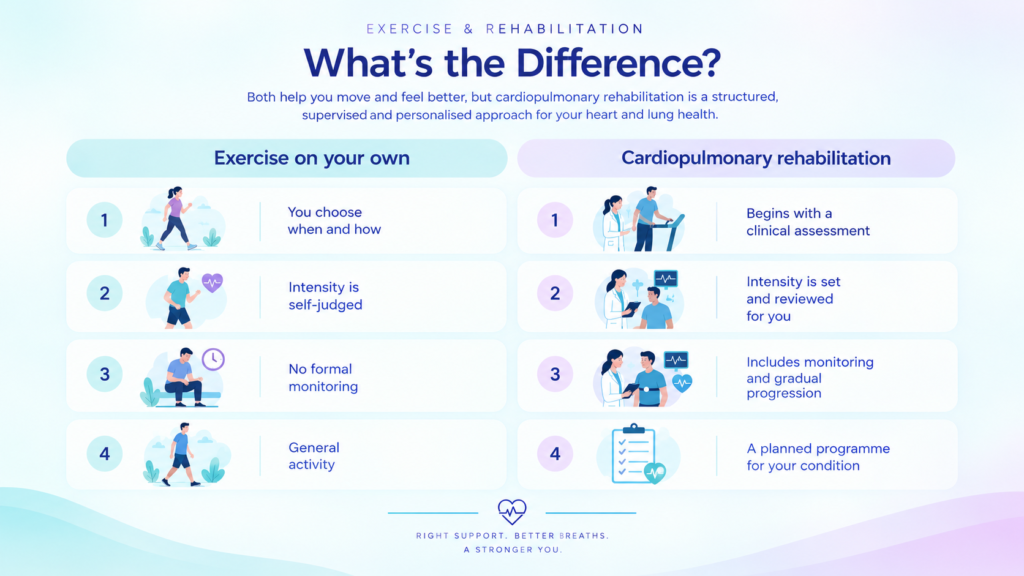
If you want the full picture of the supervised, programme-based route, see our guide to cardiopulmonary rehabilitation for PAH. For many people, the two work together: a supervised start, then safe activity as part of daily life. The modern view of exercise and pulmonary arterial hypertension is not about avoidance, but about doing the right amount in the right way.
Make activity work for you
The honest summary is simple. For most people with stable PAH, the risk lies in the extremes, in doing nothing and losing fitness, or in pushing too hard and ignoring the warning signs. Safe exercise for pulmonary arterial hypertension sits between the two, and the sweet spot is different for every person.
That is why a short conversation with your specialist is worth more than any general plan. They can look at your symptoms, your tests, and your treatment, and tell you where your own limits sit and how to move them over time.
Dr Prashant Bobhate sees this regularly at the Children’s Heart Centre, Kokilaben Dhirubhai Ambani Hospital in Mumbai, which runs one of Western India’s first dedicated pulmonary hypertension clinics. If you or your child has PAH and wants to be more active, ask a pulmonary hypertension specialist what is safe for you, and build from there.
Disclaimer – This article is intended for educational purposes and does not replace individualised medical advice from a pulmonary hypertension specialist or rehabilitation professional.