

Key takeaways
- Cardiopulmonary rehabilitation for PAH is a supervised programme of tailored exercise, monitoring, and education. It is not the same as a normal gym routine.
- Current guidelines recommend it for people whose PAH is stable and who are already on the right medicines.
- A specialist decides whether it is safe for you and how it should run. This is not something to begin on your own.
- The clearest proven benefits are better walking ability and better quality of life. Rehabilitation is not a cure.
- A programme can blend gentle aerobic activity, light strength work, breathing training, and education, built up slowly.
- In India, expert guidance supports structured rehabilitation delivered in supervised, home, or hybrid forms, with low-cost additions such as supervised yoga.
If you live with pulmonary arterial hypertension (PAH), you may have been told to take it easy and avoid effort. For many years, that was the usual advice. It has changed.
Doctors now know that the right kind of exercise, done under supervision, can help many people with PAH feel better and do more. That planned programme is called cardiopulmonary rehabilitation for PAH. You may also see it described as pulmonary rehabilitation for PAH, or as pulmonary hypertension rehabilitation. This guide explains what it involves, who it suits, how it is kept safe, and what the evidence actually shows.
If you live with pulmonary arterial hypertension (PAH), you may have been told to take it easy and avoid effort. For many years, that was the usual advice. It has changed.
Doctors now know that the right kind of exercise, done under supervision, can help many people with PAH feel better and do more. That planned programme is called cardiopulmonary rehabilitation for PAH. You may also see it described as pulmonary rehabilitation for PAH, or as pulmonary hypertension rehabilitation. This guide explains what it involves, who it suits, how it is kept safe, and what the evidence actually shows.
What is cardiopulmonary rehabilitation for PAH?
Cardiopulmonary rehabilitation for PAH is a planned, medically supervised programme that uses tailored exercise, close monitoring, and patient education to improve how well you move and live each day.
Cardiopulmonary rehabilitation for pulmonary arterial hypertension is built around your condition, not around a general fitness goal. Some people need more gentle aerobic work, others need light strength training or breathing support. The starting point depends on your symptoms, your exercise capacity, your oxygen levels, your current treatment, and how stable your PAH is.
That is what sets it apart from joining a gym and following a standard plan. Trained staff set the level, watch how your body responds, and build up the effort only when it is safe.
One point matters above all. Rehabilitation is added to your medical treatment. It never replaces your PAH medicines. The 2022 ESC/ERS guidelines recommend supervised exercise training for people with PAH who are already on medical therapy, as a strong (Class I, Level A) recommendation.
Why does pulmonary arterial hypertension make physical activity harder?
In PAH, the pressure is too high in the arteries that carry blood from the heart to the lungs. The right side of the heart then has to push harder to move blood through.
During activity, a healthy heart lifts its output to meet the extra demand. In PAH, that lift is limited. So you feel breathless and tired sooner than you expect. Some people also notice dizziness or chest discomfort when they push too hard.
These symptoms are uncomfortable, so it is natural to avoid the things that bring them on. Many people then do less and less. Over time, the body loses fitness, a change called deconditioning, and ordinary tasks feel harder still. The cycle looks like this:
PAH, then harder exertion, then less activity, then deconditioning, then even lower exercise capacity.
Rehabilitation is designed to break the functional side of that cycle. The aim is to rebuild stamina slowly and safely, while keeping exercise within a range your heart can handle.
Who is cardiopulmonary rehabilitation for, and when should it begin?
Pulmonary arterial hypertension rehabilitation is not suitable in exactly the same way for every person with PAH.
Guidance is clear on the main group it suits. Supervised exercise training for PAH is recommended for people whose condition is stable and who are already on medical therapy. Rehabilitation usually begins once the condition is clinically stable, not during a flare or a period of change. A pulmonary hypertension specialist judges whether it is right for you and how it should be delivered. The evidence is more limited for people with very severe disease, so the decision is always individual.
An assessment can be especially useful for people who have:
- Reduced exercise capacity
- Trouble with routine physical activity
- Physical deconditioning
- Breathlessness or fatigue during effort
- Lost confidence with activity
In India, the picture is the same. The 2026 PVRI India Taskforce consensus, led by Dr Prashant Bobhate, keeps supervised exercise training as a Class I, Level A recommendation for people with PAH who are stable on their medicines. In short, the Indian expert view matches the international one.
What assessments happen before PAH rehabilitation begins?
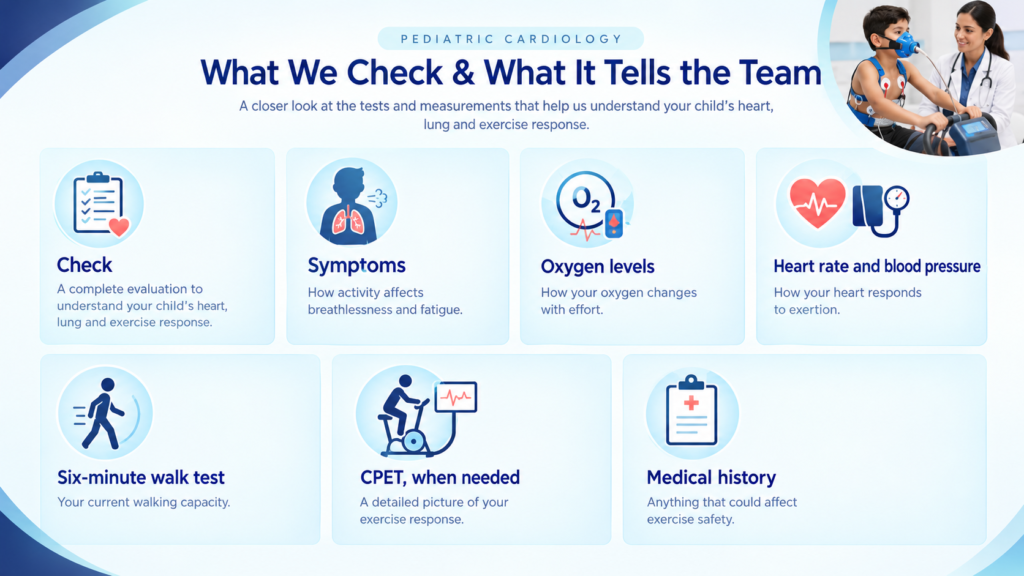
A good programme starts with a careful check, not with an exercise session. The team needs a clear picture of where you are before building a plan.
The team may review your medical history, your current PAH treatment, your symptoms, and other conditions that could affect safety. Two tests are used often.
The six-minute walk test
The six-minute walk test (6-minute walk test) measures how far you can walk in six minutes under set conditions. It gives a simple, reliable read on your current exercise capacity. It is usually repeated after a few weeks, so you and your team can see, in plain numbers, whether the programme is helping.
Cardiopulmonary exercise testing (CPET)
Cardiopulmonary exercise testing gives a more detailed look at how your heart, lungs, and muscles respond to effort. It may be used when the team needs to understand what is limiting you, and when the test is available.
Other checks that guide the plan
The team may also look at the factors below. Together, these set a safe starting point and a baseline to measure progress against.
What does a cardiopulmonary rehabilitation programme for PAH include?
A programme usually blends a few parts, each kept gentle and controlled. The exact mix depends on your assessment.
Aerobic activity
Aerobic exercise is the core. It builds stamina using activities such as walking, stationary cycling, stepping, or stair climbing. The 2026 PVRI India consensus describes these same activities, at a moderate effort guided by how hard the work feels, in short sessions of around ten to fifteen minutes that are built up gradually over the weeks. Your team sets the exact level for you.
Light strength work
Strength training, also called resistance training, may be added for the main muscle groups, using controlled movements and a resistance level chosen for you. It matters because reduced activity can weaken muscles over time. The focus stays on steady breathing. Holding your breath or straining is avoided, because both can add sudden stress on the heart in PAH.
Breathing and inspiratory muscle training
Some programmes include training for the muscles you use to breathe. The India consensus lists this as a possible add-on alongside aerobic and strength work. It supports the rest of the plan rather than replacing it.
Warm-up, cool-down, and education
Each session usually opens with a gentle warm-up and closes with a cool-down, so your effort rises and falls slowly rather than in sudden jumps. Education runs through the whole programme. You learn to pace yourself, save energy for what matters, spot warning signs early, use oxygen correctly if it is prescribed, and know when to seek advice.
The Indian consensus adds a useful local touch here. It supports blending culturally relevant, low-cost options, such as supervised yoga-based breathing and movement, into standard programmes, which makes rehabilitation easier to keep up in Indian settings.
How is exercise monitored and kept safe during cardiopulmonary rehabilitation for PAH?
Monitoring is one of the main things that separates structured rehabilitation from ordinary exercise. It is how a programme stays safe.
During sessions, the team keeps an eye on how you respond. The 2026 PVRI India consensus sets out what to watch:
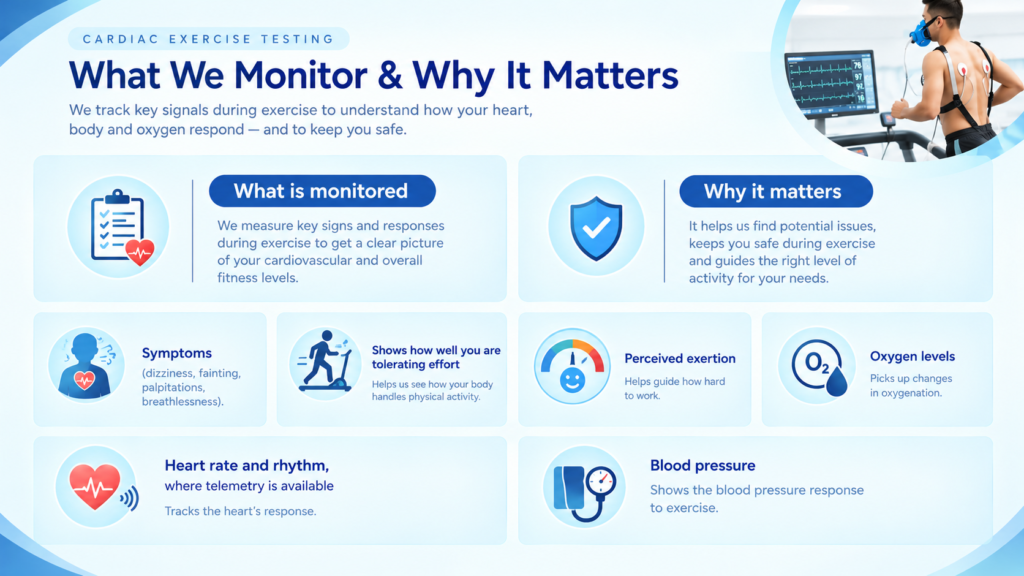
The point of monitoring is not to make you anxious about every number. It lets the team adjust the session when needed. The team also sets your targets. This is why you should not fix your own oxygen or heart-rate goals from a home device. Oxygen support, if you need it, is guided by your clinical team, not by a pulse oximeter reading alone.
What benefits does cardiopulmonary rehabilitation offer people with PAH, and what does the evidence show?
Research on exercise training in pulmonary arterial hypertension points to clear functional gains. The strongest evidence links rehabilitation to better exercise capacity and better quality of life, rather than to curing the disease.
In a large European trial of 116 people with PAH or a related condition called CTEPH, all already on medication, a supervised training programme improved the six-minute walking distance by about 34 metres more than usual care. The same study found better quality of life, better functional class, and higher peak oxygen uptake, and the programme was judged safe when run properly (Grünig et al., 2021).
Wider reviews that pool many studies point the same way, with average gains in walking distance often around 50 metres or more, and serious problems uncommon in stable, supervised patients (ERS statement). In day-to-day terms, that can mean walking further before you stop, managing stairs more easily, or getting through normal tasks with less breathlessness.
What the evidence does not show is just as important. Rehabilitation is not a cure. It does not reliably lower lung pressure for everyone, and it is not a reason to change or stop your PAH medicines. The honest promise is better function and quality of life, as one part of complete care.
When should someone with PAH pause or stop exercising?
Certain symptoms during exercise need attention straight away. If you are in a programme, your team will have told you what to watch for and what to do.
Stop or ease off, and get advice, if you develop:
- Chest pain or discomfort
- Fainting or near-fainting
- Strong dizziness or lightheadedness
- New or unusual palpitations
- Breathlessness that is severe or clearly beyond the expected effort
- Any other symptom your team has flagged for you
Your rehabilitation team also watches for signs that your heart is struggling or that your condition is changing. These warning signs are a key reason why starting under supervision matters so much in PAH.
How is cardiopulmonary rehabilitation different from everyday exercise for PAH?
Everyday activity and cardiopulmonary rehabilitation overlap, but they are not the same thing. For someone with PAH, the difference is mostly about assessment, prescription, and monitoring.
Everyday exercise can be done on your own, fits around your daily life, and allows you to choose your own intensity. It often focuses on improving general fitness without clinical monitoring.
In contrast, cardiopulmonary rehabilitation begins with a clinical assessment and is tailored to your pulmonary arterial hypertension (PAH) and test results. Exercise intensity is set according to your individual needs, with the aim of safely improving your physical function. The program also includes clinical monitoring and gradual progression to support safe, effective exercise.
So the real question for someone with PAH is not whether exercise is good or bad. It is what type of activity suits you, at what level, and under what conditions. That guided, monitored approach is what makes exercise rehabilitation for PAH different from simply doing more.
Can cardiopulmonary rehabilitation for PAH continue at home?
Often, yes. Many people start under supervision and then carry on at home with a plan the team has set and keeps reviewing. The 2026 PVRI India consensus recognises supervised, home-based, and hybrid models as valid ways to deliver rehabilitation, which helps people who live far from a centre.
The supervised start still matters. Home exercise works as a continuation of a monitored programme, not as a replacement for it. You keep to the targets your team set, watch for the same warning signs, and attend review visits so the plan can be checked and updated. If your symptoms change, the home part may need to pause while your specialist takes another look.
Speak to a pulmonary hypertension specialist before you start
Cardiopulmonary rehabilitation for PAH works best as one part of complete, specialist-led care. The right plan depends on your tests, your symptoms, and how your heart is coping, which is why the first step is always a proper assessment. At the Children’s Heart Centre, Kokilaben Dhirubhai Ambani Hospital in Mumbai, Dr Prashant Bobhate runs a dedicated, multidisciplinary pulmonary hypertension clinic, one of the first of its kind in Western India. If you or your child lives with PAH, talk to a pulmonary hypertension specialist about whether rehabilitation is suitable, and how to begin it safely.