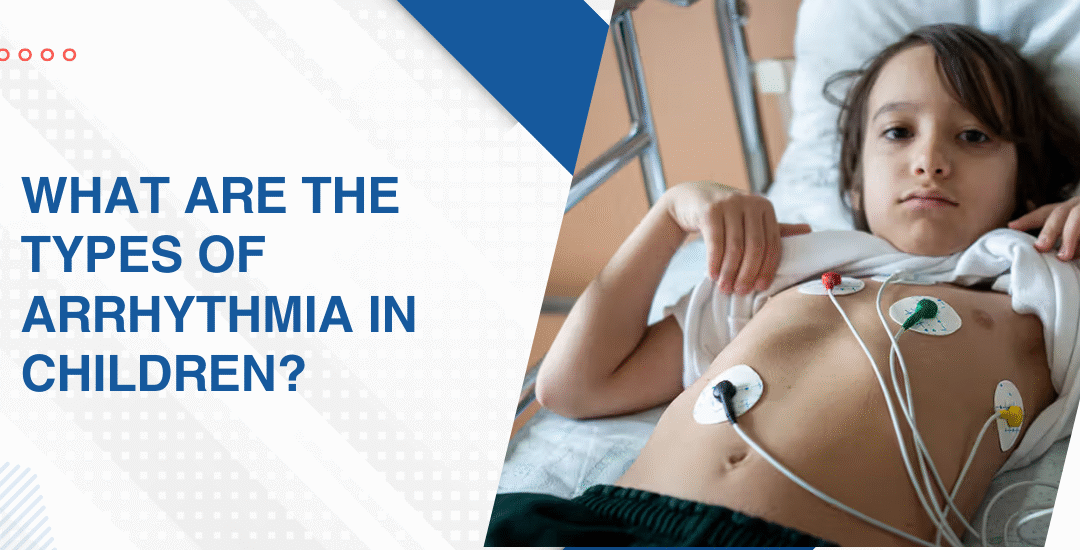
Not one thing. That’s the first thing to understand. Arrhythmia in children covers a whole family of conditions where the heart beats too fast, too slow or just plain irregularly and each type has a different cause, a different risk level and a completely different treatment path that needs to be mapped out carefully.
“Parents hear the word arrhythmia and immediately imagine the worst. But some of these rhythm problems are completely benign and some genuinely need treatment fast and knowing which one you’re dealing with changes everything about what happens next,” says Dr. Prashant Bobhate, Pediatric Cardiologist in Mumbai, India.
What Are the Most Common Types of Arrhythmia Seen in Children?
Most arrhythmias in children don’t come with a dramatic presentation. A child complains of a fluttering in the chest. A parent notices the heart racing for no obvious reason at rest.
- SVT: Supraventricular tachycardia is the single most common significant arrhythmia in children. The heart suddenly races to 200 or even 300 beats per minute out of nowhere, episodes start and stop abruptly and children often describe a pounding sensation in the chest or throat that’s hard to put into words.
- Sinus bradycardia: The heart beats slower than normal for the child’s age. In fit athletic teenagers this is often completely normal but in younger children or those with underlying cardiac conditions a persistently low rate needs proper evaluation rather than casual reassurance.
- Heart block: The electrical signal from the upper chambers to the lower ones gets delayed or completely interrupted somewhere along its path. Some degrees of heart block need no treatment and others eventually need a pacemaker depending entirely on how severely the conduction is affected.
- Ventricular tachycardia: Rarer in children than SVT but significantly more serious when it appears. The rhythm originates from the lower chambers and can compromise cardiac output rapidly so this one never gets the watchful waiting approach that some others can afford.
If your child has been told they have an abnormal heart rhythm, a full evaluation at a dedicated pediatric arrhythmia centre is what gives you a real understanding of the type, the risk and the best next step.
Are There Types of Arrhythmia That Look Harmless But Aren't?
Yes. And that’s the part families most need to hear. Some rhythm abnormalities sit quietly for years, behave themselves on every routine ECG and then show up differently under physical or emotional stress.
- Long QT syndrome: The ECG shows a prolonged interval between two specific waveforms and on paper it can look like almost nothing. But in the wrong circumstances, exercise, a sudden loud noise, even swimming, it can trigger a dangerous rhythm that produces sudden cardiac arrest without any prior warning at all.
- WPW syndrome: An extra electrical pathway exists between the upper and lower chambers that wasn’t there by design. Most children with WPW live completely normally and never know it’s there until an ECG catches it but a subset can develop very fast rhythms under certain conditions that do need catheter ablation to fix properly.
- Ectopic beats: Isolated extra beats that feel like a thump or a skip in the chest are extremely common in children, often completely benign and frequently more distressing to the parent than to the cardiac conduction system. But frequent ectopics deserve at least one proper evaluation to confirm there’s no structural issue sitting underneath them.
- Junctional rhythm: The heart’s pacemaker activity shifts from the sinus node to the junction between chambers, usually because the sinus node is firing too slowly. Often discovered incidentally, rarely symptomatic on its own but always worth understanding in the context of whether it’s truly isolated or a signal of something else.
Parents wondering what cardiac warning signs sometimes precede an arrhythmia diagnosis in children should read this piece on how to spot the early signs of heart disease in neonates because the patterns that show up in newborns are often the earliest version of what gets formally identified years later.
Why Choose Dr. Prashant Bobhate for Paediatric Arrhythmia Care in Mumbai?
You want someone who has seen every version of this. Not just the textbook ones but the child whose SVT only triggers during school exams and the teenager whose WPW sat silently for three years before one football match changed the picture entirely. Dr. Prashant Bobhate has spent over 12 years working across the full spectrum of paediatric cardiac conditions including complex arrhythmia presentations at every age from newborn through adolescence. Trained at Escorts Heart Institute New Delhi and completed advanced fellowship at the University of Alberta Canada with focused exposure to paediatric electrophysiology alongside structural disease.
Schedule a consultation to find out if a cure is possible and what the right treatment plan looks like for you.
FAQs
Can a VSD close on its own without surgery?
Yes, small muscular VSDs frequently close spontaneously in the first two years of life but this needs regular echo confirmation and a specialist following the trajectory rather than assuming closure is happening without checking.
How long does recovery take after VSD surgery in a child?
Most children spend around five to seven days in hospital after surgical VSD repair and return to normal activity within six to eight weeks depending on their age, overall health and how the heart responds post-operatively.
Is a heart murmur in a newborn serious?
Not always but it always needs a formal echo evaluation because some innocent murmurs mean nothing while others are the first sound of a defect that needs early intervention to prevent long term damage.
What happens if a newborn heart problem goes undetected?
Some defects worsen rapidly in the first weeks of life as the newborn circulation changes and delays in detection can narrow or close the window for the least invasive treatment options available.
References:
- Ventricular Septal Defect, MedlinePlus, U.S. National Library of Medicine — https://medlineplus.gov/ency/article/001099.htm
- Ventricular Septal Defect, National Heart Lung and Blood Institute — https://www.nhlbi.nih.gov/health/congenital-heart-defects