
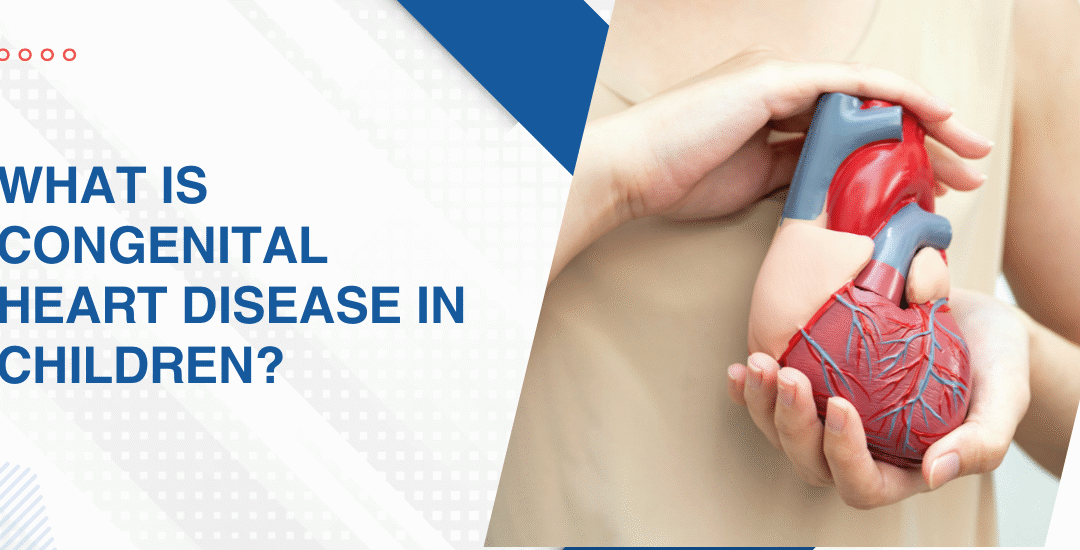
Congenital Heart Defects (CHD) consist of structural defects of the heart which exist at birth and affect approximately one in every 100 newborns. These defects occur when the heart or blood vessels fail to develop completely during the gestation process. There is a wide variety of CHD, from small defects that require monitoring to larger, life-threatening disease. Treatment can include careful monitoring, medications, and surgical intervention.
“Most children with congenital heart disease can live full healthy lives when the condition is caught early and managed with the right plan from the start,” says Dr. Prashant Bobhate, Pediatric Cardiologist in Mumbai, India.
What Are the Most Common Types of Congenital Heart Disease in Children?
This isn’t one condition wearing one face. It’s a whole group of structural problems each sitting in a different part of the heart each doing completely different things to blood flow and oxygen delivery.
- Ventricular Septal Defect (VSD): A hole between the lower chambers letting blood go places it really shouldn’t and while smaller ones sometimes close on their own bigger ones silently pile pressure onto a heart that’s still learning how to work properly.
- Atrial Septal Defect (ASD): Opening between the upper chambers that is genuinely excellent at hiding because the early signs look like absolutely nothing worrying for a very long time and most families have no idea it’s there.
- Tetralogy of Fallot (TOF): Four separate problems hitting the heart simultaneously, oxygen in the blood drops and the skin takes on that bluish colour that stops parents cold the very first time they see it on their own child’s face.
- Transposition of the Great Arteries (TGA): The two main arteries have swapped positions completely and this one doesn’t wait around because it becomes life threatening within the first hours if nobody’s caught it yet.
What type it is, where exactly it sits and what it’s doing to blood flow moment to moment all feed into the right congenital heart disease treatment path for your child specifically.
What Warning Signs Tell You Something Is Wrong With Your Child's Heart?
Weeks go by sometimes. Months even. Because this doesn’t show up wearing a sign. It shows up wearing the face of a tired baby or a child who just seems flat or a kid who always needs to sit down before everyone else does.
- Breathlessness doing almost nothing: A child struggling to breathe through things other kids their age breeze through without noticing is showing you something that deserves actual investigation rather than watching and hoping it settles on its own.
- That bluish tint around lips or fingernails: Wrong colour for a child full stop and it means not enough oxygen is making it into the blood which isn’t a watch and see situation from the sofa under any circumstances.
- Feeding feels like a marathon and weight just isn’t happening: A baby who exhausts themselves trying to get through a feed and still isn’t growing the way the charts say they should has something going on that needs a proper cardiac look not a formula change.
- Always the tired one, always the one who can’t keep up: If your child is consistently the kid sitting out, crashing early and running on empty while everyone else is still going that pattern is worth chasing down properly.
Parents already watching some of this unfold with their own child should read this piece on how to spot the early signs of heart disease in neonates which goes through what these signs genuinely look like during those first weeks when everything still feels new and uncertain.
Why Choose Dr. Prashant Bobhate for Congenital Heart Disease Treatment in Mumbai?
Your child’s heart isn’t the place for someone who dips into this occasionally between other work. Dr. Prashant Bobhate spent over 12 years going deep into specifically this area. Trained at Escorts Heart Institute in New Delhi then made a deliberate trip to the University of Alberta in Canada just to go further into it. His team carried out India’s very first successful Transcatheter Potts Shunt and right now actively manages over 400 children on advanced therapy. He doesn’t reach for a standard protocol. He sits with what’s actually happening inside your child’s heart and builds entirely from there.
📞 Call Now: (+91) 8080 826 898
A proper evaluation gives you real answers about what’s happening with your child’s heart and what the right next step actually is.
FAQs
Can congenital heart defects be detected before birth?
Yes fetal echocardiography between 18 to 22 weeks can identify most structural heart defects before your baby has even taken their first breath outside the womb.
Are congenital heart defects genetic?
Some types carry a genetic link but plenty occur without any family history and without any clear reason anyone can point to even after thorough investigation.
Do all congenital heart defects require surgery?
Not always. Some defects close without help or get managed with medication while others do need surgical or catheter based intervention depending on size and severity.
Can children with congenital heart defects live a normal life?
Yes. Most children who get the right treatment at the right time go on to live completely active normal lives without any lasting limitations whatsoever.
References:
- Congenital Heart Defects, MedlinePlus, U.S. National Library of Medicine — https://medlineplus.gov/congenitalheartdefects.html
- Congenital Heart Disease in Children, National Heart Lung and Blood Institute — https://www.nhlbi.nih.gov/health/congenital-heart-defects