Adults Live Normal Lives After TOF Surgery

Adults Live Normal Lives After TOF Surgery

Yes. Most adults who had complete TOF repair in childhood go on to live full, active lives with work, relationships, exercise and family. But normal doesn’t mean unsupervised. It means living well with the right follow up in place, because a repaired TOF heart still needs someone paying attention to it across the decades.

“A repaired TOF is not a fixed TOF in the sense of forgotten. It’s a heart that did something remarkable surviving a complex correction and it deserves to be watched carefully for the rest of that person’s life,” says Dr. Prashant Bobhate, Pediatric Cardiologist in Mumbai, India.

What Can Adults With Repaired TOF Typically Do?

Quite a lot, actually. Most repaired TOF patients hold jobs, raise families, play sports and travel without restriction. The life most people picture when they hear congenital heart surgery outcome is genuinely achievable for this group if the repair was complete and the follow up has been consistent.

  • Exercise: Most adults with good repair and normal right heart function can exercise regularly including gym, swimming and recreational sports with no hard restrictions on activity.
  • Work: Full time employment across physically and mentally demanding fields is entirely normal for repaired TOF patients who are doing well on long term follow up.
  • Pregnancy: Many women with repaired TOF have successful pregnancies though a detailed cardiac assessment before conception is essential to understand the specific risks for each individual.
  • Travel: Flying, travel and normal life activities are generally fine for well managed repaired TOF patients with no significant residual defects or arrhythmia burden.

Getting that assessment properly and understanding exactly what your repaired heart looks like today is what the Tetralogy of Fallot team evaluates in every adult follow up consultation so that lifestyle advice is specific to the person rather than generic.

What Do Adults With Repaired TOF Still Need to Watch?

Because repaired doesn’t mean risk free. The surgical correction done in infancy or childhood was life saving but it wasn’t permanent in every sense. Pulmonary regurgitation, right heart enlargement and arrhythmia are real issues that can surface years or even decades after what looked like a perfectly successful repair.

  • Pulmonary regurgitation: Leakage back through the pulmonary valve after repair is common and over years can stretch and weaken the right ventricle in ways that eventually need a second intervention if it’s been left unchecked.
  • Arrhythmia risk: Adults with repaired TOF carry a higher than average risk of both slow and fast heart rhythms and some of these are serious enough to cause sudden cardiac events if not caught and managed correctly.
  • Right heart function: Right ventricular size and function needs regular imaging because the right heart compensates quietly for a long time before symptoms appear and by then the window for easy intervention may have passed.
  • Pulmonary valve replacement: Some adults with repaired TOF will eventually need their pulmonary valve replaced and the timing of that decision is critical to getting the right heart through it in good enough shape to benefit fully.

Adults living with repaired TOF who want to understand the longer journey should read this piece on how to spot the early signs of heart disease in neonates which explains how TOF announces itself early and why the timing of that first repair shapes so much of what the adult heart looks like years later.

Why Choose Dr. Prashant Bobhate for TOF Follow Up in Mumbai?

Spotting TOF early is only part of it. What comes next depends entirely on who’s reading the echo, planning the repair and managing everything between diagnosis and the operating table. Dr. Prashant Bobhate spent over 12 years working with children at every stage of congenital heart disease. TOF from fetal diagnosis through surgical planning through long term follow up. Trained at Escorts Heart Institute in New Delhi then went deliberately to the University of Alberta in Canada for advanced paediatric cardiac fellowship training. His team performed India’s very first successful Transcatheter Potts Shunt and actively manages over 400 children on advanced cardiac therapy right now. He doesn’t just diagnose and hand you a referral letter. He stays in the room for everything that comes after.

Schedule a consultation to find out if a cure is possible and what the right treatment plan looks like for you.

FAQs

Can repaired TOF patients live a normal lifespan?

Most adults with complete repair who stay in regular follow up do live close to normal lifespans though long term outcomes depend on the quality of the original repair and ongoing cardiac monitoring.

Do repaired TOF adults need medication for life?

Not always but some patients need medication for arrhythmia or heart function and all repaired TOF adults need lifelong cardiac follow up regardless of how well they feel.

Can repaired TOF come back or get worse?

The original defect doesn’t return but complications like pulmonary regurgitation and arrhythmia can develop years after repair which is exactly why regular follow up is not optional.

How often should a repaired TOF adult see a cardiologist?

At minimum every one to two years with an echocardiogram and more frequently if there is any evidence of pulmonary regurgitation, arrhythmia or right ventricular enlargement.

References:

Early Symptoms of TOF in Babies

Early Symptoms of TOF in Babies

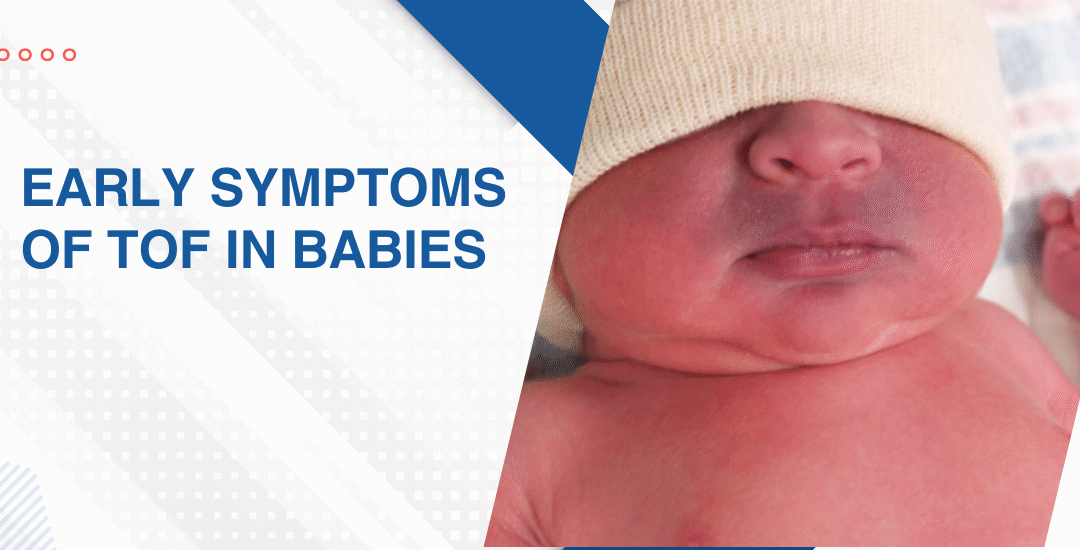
The earliest sign of Tetralogy of Fallot in babies is a bluish tint around the lips and fingertips caused by low oxygen in the blood. Babies with TOF also feed poorly, tire quickly, breathe faster than normal and don’t gain weight the way they should. Some are diagnosed before birth. Others make themselves known in those first weeks at home before anyone’s connected the dots.

“The blue around the lips is the sign most parents remember but TOF often announces itself more quietly first through a baby who just seems to be working too hard at everything,” says Dr. Prashant Bobhate, Pediatric Cardiologist in Mumbai, India.

What Are the First Signs of TOF That Show Up in a Baby?

Most parents don’t know what TOF looks like in those first days at home. And the earliest signs don’t walk in wearing a label. They show up in feeds, in breathing, in how hard that small body works doing things that should come easily.

  • Blue colour: A bluish tint around the mouth or fingernails during feeding, crying or any effort is the signature sign and the one that tends to get a baby seen the same day.
  • Fast breathing: A resting respiratory rate that consistently sits too high even when the baby is calm and undisturbed means the heart and lungs are working harder than they should be.
  • Poor feeding: A baby who tires mid-feed, sweats during it or takes far too long to finish a small amount is burning energy the heart simply can’t replace fast enough.
  • Tet spells: Sudden episodes where the baby turns deeply blue, becomes distressed or goes floppy during crying or feeding are TOF’s most urgent early sign and they don’t announce themselves in advance.

Catching these early is exactly what changes how the Tetralogy of Fallot conversation starts and how much time the surgical team has to work with before the situation becomes urgent.

What Other Early Signs Do Families Miss in TOF Babies?

The blue spells get all the attention. But the quieter signs that show up weeks before any tet spell are the ones families look back on and wish someone had connected earlier. They don’t look cardiac.

  • Poor weight gain: A baby consistently falling off the growth chart despite adequate feeding and no obvious gut reason is often showing what chronic cardiac strain looks like from the outside.
  • Visible effort breathing: Skin pulling in between the ribs with every breath means the work of breathing has gone up and the body is recruiting extra muscles just to keep oxygen coming in.
  • Squatting behaviour: Once mobile a child with unrepaired TOF who instinctively squats during activity is doing something physiologically clever that temporarily pushes more blood toward the lungs without knowing why.
  • Constant irritability: A baby who seems unsettled without obvious cause especially after feeds is often in a state of mild chronic oxygen deficit that makes everything feel uncomfortable in a way they can’t tell you about.

Parents seeing any of this at home should read this piece on how to spot the early signs of heart disease in neonates which goes through exactly what to watch for when everything still feels new and impossible to interpret properly.

Why Choose Dr. Prashant Bobhate for TOF Care in Mumbai?

Spotting TOF early is only part of it. What comes next depends entirely on who’s reading the echo, planning the repair and managing everything between diagnosis and the operating table. Dr. Prashant Bobhate spent over 12 years working with children at every stage of congenital heart disease. TOF from fetal diagnosis through surgical planning through long term follow up. Trained at Escorts Heart Institute in New Delhi then went deliberately to the University of Alberta in Canada for advanced paediatric cardiac fellowship training. His team performed India’s very first successful Transcatheter Potts Shunt and actively manages over 400 children on advanced cardiac therapy right now. He doesn’t just diagnose and hand you a referral letter. He stays in the room for everything that comes after.

Schedule a consultation to find out if a cure is possible and what the right treatment plan looks like for you.

FAQs

When do TOF symptoms appear?

Most babies show symptoms within the first few weeks to months of life though some are diagnosed before birth through fetal echocardiography.

Is lip blueness always TOF?

Not always but cyanosis in any baby always needs urgent cardiac evaluation that day regardless of the suspected cause.

Can TOF be missed at birth?

Yes. Mild TOF can pass routine newborn screening which is why persistent poor feeding, fast breathing or blueness during effort needs cardiac follow up without delay.

Is TOF fatal without surgery?

Without repair risks increase significantly over time but children who get complete surgical repair between 3 and 6 months go on to live normal active lives.

References:

What Are The Symptoms Of VSD In Adults?

What Are The Symptoms Of VSD In Adults?

Adults with VSD most commonly experience breathlessness during exertion, fatigue that doesn’t improve with rest, heart palpitations and reduced exercise tolerance compared to people their age. Small VSDs often cause no symptoms at all and get found entirely by accident. Larger ones that were never repaired in childhood are the ones that eventually start making themselves known in ways that are hard to keep ignoring.

“A VSD in an adult isn’t always a childhood problem that was missed. Some are genuinely small enough to have caused nothing for decades and then one day the heart quietly tells you it’s been there all along,” says Dr. Prashant Bobhate, Pediatric Cardiologist in Mumbai, India.

What Physical Symptoms Does a VSD Cause in Adults?

Most adults with an unrepaired VSD spent years being told their murmur was innocent or that nothing needed doing. And for a small defect that’s often true. But a larger one that’s been quietly doing its thing for twenty or thirty years eventually starts showing up in how the body feels during ordinary life.

  • Breathlessness on exertion: Getting winded doing things that shouldn’t wind you, stairs that were fine last year, walks that now feel harder than they should.
  • Persistent fatigue: Not tiredness that sleep fixes but a baseline heaviness that sits there regardless of how much rest happens.
  • Palpitations: The heart beating irregularly, racing unexpectedly or fluttering during activity or sometimes completely at rest without any obvious trigger.
  • Reduced exercise tolerance: Noticing you can’t keep up the way you used to and quietly adjusting life around that limitation without ever really asking why.

These are exactly the symptoms that make getting the right ventricular septal defect assessment done properly matter rather than continuing to live around things that have a real explanation sitting right behind them.

What More Serious Symptoms Tell You Something Has Changed?

Because there’s a difference between a VSD that’s been stable for years and one that has started pushing the heart and the lungs into territory they were never meant to sustain long term. The symptoms in the second category aren’t subtle and they don’t wait politely.

  • Cyanosis around lips or fingertips: Bluish discolouration means oxygen levels have dropped and that’s not something to observe for a few days before calling anyone.
  • Swelling in the legs or ankles: Fluid accumulating in the lower limbs is the right heart telling you it’s struggling to keep up with what it’s being asked to do.
  • Chest pain during activity: Any chest pain during exertion in someone with a known cardiac history is a same day assessment not a wait and see situation.
  • Fainting or near fainting: Losing consciousness or nearly doing so during any level of activity means the heart isn’t maintaining adequate output under load and that needs investigating urgently.

Adults experiencing any of these symptoms and wanting to understand what the longer term picture of untreated pulmonary pressure looks like should read this piece on when is lung transplant necessary for pulmonary hypertension which explains honestly what happens when the pressure in the lung vessels has been elevated for too long without the right intervention.

Why Choose Dr. Prashant Bobhate for Balloon Valvuloplasty in Mumbai?

An adult presenting with VSD symptoms needs someone who understands both the congenital cardiac history and what decades of a shunt does to the pulmonary circulation over time. Dr. Prashant Bobhate spent over 12 years working specifically inside congenital heart disease from newborn diagnosis through childhood repair through adult follow up and late presentations. Trained at Escorts Heart Institute in New Delhi then went deliberately to the University of Alberta in Canada for advanced paediatric cardiac fellowship training. His team performed India’s very first successful Transcatheter Potts Shunt and actively manages over 400 children and young adults on advanced therapy right now. He doesn’t look at a murmur in isolation. He looks at what that murmur has been doing to the heart and lungs for every year it’s been there.

Schedule a consultation to find out if a cure is possible and what the right treatment plan looks like for you.

FAQs

Can a VSD cause symptoms for the first time in adulthood?

Yes especially if the defect was small enough in childhood to avoid detection but large enough to gradually strain the heart and lung circulation over decades.

Is VSD in adults dangerous?

A small stable VSD with no pressure changes or chamber enlargement is often managed safely with monitoring but a larger unrepaired defect causing pulmonary hypertension becomes genuinely serious over time.

Can a VSD be closed in adults?

Yes. Device closure or surgical repair is possible in adults if the pulmonary pressure hasn’t crossed into irreversible territory and a full cardiac assessment determines whether the window for intervention is still open.

What happens if a VSD in adults goes untreated?

A significant unrepaired VSD can eventually lead to Eisenmenger syndrome where lung vessel damage becomes permanent and the option for surgical repair closes entirely which is why timing of assessment matters.

References:


Recovery Time for Balloon Valvuloplasty?

Recovery Time for Balloon Valvuloplasty?

Most children go home within 24 to 48 hours after balloon valvuloplasty and are back to normal activity within one to two weeks. No open heart surgery. No long hospital stay. The procedure goes in through a small catheter at the groin and most families are genuinely surprised by how quickly their child bounces back after it.

“Parents usually come in expecting weeks of recovery and leave surprised it was days. Balloon valvuloplasty is one of those procedures where the child often recovers faster than the parents do from the worry,” says Dr. Prashant Bobhate, Pediatric Cardiologist in Mumbai, India.

What Does Recovery From Balloon Valvuloplasty Look Like Day by Day?

Most families picture post-cardiac recovery as weeks of fragility and restriction. Balloon valvuloplasty doesn’t work that way. Because nothing was cut open the body isn’t recovering from a wound it’s recovering from a catheter and the difference in timeline is enormous.

  • Day one: Child stays in hospital for monitoring, the groin entry site is checked, feeds resume normally and most children are sitting up and asking for food within a few hours of coming back from the procedure room.
  • Day two discharge: Most children go home the next morning with a small dressing on the groin, clear instructions on what to watch for and a follow up echocardiogram already scheduled to confirm the valve is opening the way it should.
  • Week one at home: Normal light activity is fine, heavy running and rough play gets avoided for about a week and school can usually restart within five to seven days depending on how the child feels and how the groin site looks.
  • Week two onwards: Full normal activity resumes for most children and the follow up echo at six to eight weeks is usually the appointment where families finally exhale because the valve numbers confirm the procedure did exactly what it was supposed to do.

That predictable recovery timeline is one of the reasons pediatric balloon valvuloplasty has become the preferred first line treatment for suitable valve narrowing in children rather than open surgical repair wherever the anatomy allows it.

What Should Parents Watch for During Recovery at Home?

Because being discharged isn’t the same as being done. Most recoveries go completely smoothly. But knowing what normal looks like and what isn’t normal means you’re not spending the whole first week at home quietly spiralling every time your child winces getting off the sofa.

  • Groin site redness: A little bruising around the entry site is completely normal for several days but spreading redness, warmth or any discharge from the site means a call to the team that day rather than waiting for the follow up.
  • Fever after day two: A mild temperature on day one is common after any catheter procedure but a fever that develops or persists after the second day at home needs to be reported rather than managed with paracetamol and hope.
  • Breathing changes: Any increase in breathlessness, faster breathing at rest or a return of symptoms that were present before the procedure is the valve or the heart telling you something that needs to be looked at rather than assumed to be normal post-procedure noise.
  • Activity and feeding: A child who’s eating well, playing normally within their restrictions and sleeping comfortably is almost always recovering exactly as expected and that picture is genuinely more reassuring than any single observation on its own.

Parents wanting to understand what cardiac warning signs look like in children more broadly should read this piece on top 5 warning signs of pediatric heart failure which goes through what needs attention and what needs urgent action rather than leaving families guessing at the line between the two

Why Choose Dr. Prashant Bobhate for Balloon Valvuloplasty in Mumbai?

A short recovery only happens when the procedure itself goes well and a procedure only goes well consistently when the person doing it has done it many times before on children of every age and size. Dr. Prashant Bobhate spent over 12 years working specifically inside interventional paediatric cardiology at Kokilaben Dhirubhai Ambani Hospital. Trained at Escorts Heart Institute in New Delhi then went deliberately to the University of Alberta in Canada for advanced paediatric cardiac fellowship training.

Schedule a consultation to find out if a cure is possible and what the right treatment plan looks like for you.

FAQs

How long in hospital after balloon valvuloplasty?

Most children are discharged within 24 to 48 hours of the procedure as long as the groin site is clean and the heart rhythm is stable on monitoring.

When can my child return to school?

Most children return to school within five to seven days depending on how the groin site has healed and how comfortable they feel physically.

Is balloon valvuloplasty painful for children?

The procedure is done under general anaesthesia so there’s no pain during it and most children report only mild groin discomfort for a day or two afterwards.

Does the valve stay open permanently after balloon valvuloplasty?

In most children yes but some valves re-narrow over years and need repeat dilation or surgical repair later which is exactly why lifelong cardiac follow up continues even after a successful procedure.

References:


Pediatric Heart Specialist at Kokilaben Hospital

Pediatric Heart Specialist at Kokilaben Hospital

Dr. Prashant Bobhate is the pediatric heart specialist at Kokilaben Dhirubhai Ambani Hospital Mumbai running the Children’s Heart Centre on the second floor. He’s a dedicated pediatric cardiologist and pulmonary hypertension specialist with over 12 years of focused experience in children’s cardiac care. One of very few specialists in India running a full dedicated paediatric cardiac programme at this level.

“Every child who walks through that door deserves a proper answer about their heart. Not a rushed opinion. An actual answer built around what their specific heart is doing right now,” says Dr. Prashant Bobhate, Pediatric Cardiologist in Mumbai, India.

What Does Dr. Bobhate Treat at Kokilaben Hospital?

Most families arrive not knowing exactly what falls under paediatric cardiology or whether their child’s specific problem belongs here. It almost always does.

  • Hole in heart: VSDs, ASDs and PDAs at every size and stage from incidental newborn findings through to defects needing device closure or surgical repair depending entirely on what the specific anatomy actually shows on the echo.
  • Pulmonary hypertension: The only dedicated multidisciplinary paediatric pulmonary hypertension programme in India runs right here with over 400 children currently on advanced therapy including the newest agents available anywhere in the country.
  • Tetralogy of Fallot: Complete evaluation, pre-surgical planning and long term follow up for children with TOF from fetal diagnosis right through to adult congenital cardiology transition without losing the thread of their history along the way.
  • Fetal echo: Detailed cardiac assessment of the baby’s heart between 18 and 24 weeks for high risk pregnancies and those with anything suspicious flagged on routine anomaly scanning.

These are exactly the conditions where the right congenital heart disease specialist at the right facility makes a difference that shows up in outcomes not just in the quality of the appointment itself.

Why Is Kokilaben the Right Place for Your Child's Heart Care?

Because the specialist and the facility have to work together properly and at Kokilaben that combination exists in a way that simply isn’t available everywhere else in Mumbai.

  • India’s first: The team here performed India’s very first successful Transcatheter Potts Shunt and that milestone didn’t happen at a centre doing things the standard way with standard resources and standard ambition.
  • Advanced therapy access: Sotatercept, prostacyclin analogues and the full range of targeted pulmonary hypertension therapies are actively used here for children in a way that genuinely isn’t the case in most other centres across the country.
  • Multidisciplinary team: Cardiology, pulmonology, rheumatology, genetics and neonatology all feeding into the same case discussion for complex children rather than each specialty seeing the same child separately and never quite talking properly to each other.
  • Fetal to adult continuity: Children diagnosed before birth are followed through every stage of their cardiac journey at the same centre by a team that already knows their history completely rather than starting fresh at every single transition point.

Parents wanting to understand what early cardiac signs look like before they ever need a specialist at all should read this piece on how to spot the early signs of heart disease in neonates which goes through what these signs genuinely look like in those first weeks at home when everything still feels new and impossible to interpret.

Why Choose Dr. Prashant Bobhate for Pediatric Heart Care in Mumbai?

Some specialists see paediatric cardiology occasionally. Dr. Prashant Bobhate built an entire clinical life deliberately inside it. Trained at Escorts Heart Institute in New Delhi then made a specific trip to the University of Alberta in Canada just for advanced paediatric cardiac and pulmonary hypertension fellowship training. Over 12 years working with children at every stage and complexity of cardiac disease. India’s first Transcatheter Potts Shunt. India’s only dedicated multidisciplinary paediatric pulmonary hypertension programme. Over 400 children on advanced therapy right now. He doesn’t see your child as a case number on a referral letter. He sees a child whose heart deserves the clearest and most honest picture anyone in this field can actually give.

Schedule a consultation to find out if a cure is possible and what the right treatment plan looks like for you.

FAQs

Where is the clinic?

Children’s Heart Centre, Second Floor, Kokilaben Dhirubhai Ambani Hospital, Four Bungalows, Andheri West, Mumbai 400053.

Does he see newborns?

Yes including babies diagnosed before birth through fetal echo who need immediate postnatal cardiac evaluation from the very first hours of life.

Is fetal echo available here?

Yes for high risk pregnancies and suspected cardiac findings between 18 and 24 weeks which is the ideal window for a complete cardiac assessment before birth.

Does he treat adults with pulmonary hypertension?

His primary focus is paediatric patients but young adults transitioning from childhood pulmonary hypertension care are managed through the same dedicated programme.

References:


Call Now Button