
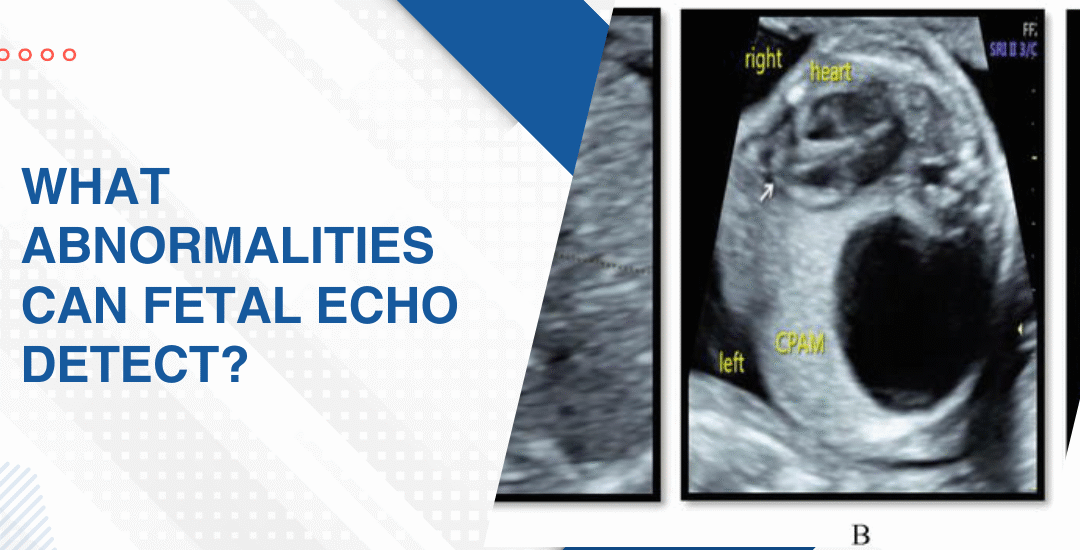
A fetal echocardiogram can detect structural heart defects, abnormal blood flow patterns, valve problems, rhythm disturbances and major vessel abnormalities in an unborn baby. It gives a far more detailed picture of your baby’s heart than a routine anomaly scan ever will. And that difference in detail is exactly why it exists as a separate scan entirely.
“A fetal echo doesn’t just look at the heart. It reads how the heart is working, how blood is moving through it and whether anything is building that needs to be caught right now rather than after birth,” says Dr. Prashant Bobhate, Pediatric Cardiologist in Mumbai, India.
What Structural Heart Abnormalities Can a Fetal Echo Detect?
Most parents walking into this scan don’t know how much it can actually see. A routine 20-week anomaly scan checks the heart briefly.
- Ventricular septal defects: Holes between the lower chambers of the heart that let blood cross where it shouldn’t and while small ones sometimes close on their own larger ones need to be on the radar before birth so nothing about the delivery or immediate care comes as a surprise.
- Transposition of the great arteries: The two main arteries leaving the heart have completely swapped positions and this is genuinely one of those findings where catching it before birth rather than in the first hours of life changes the entire outcome for that baby.
- Hypoplastic left heart syndrome: The entire left side of the heart is severely underdeveloped and without a fetal diagnosis this one walks into the delivery room completely unannounced and the difference in survival between a prepared team and an unprepared one is stark.
- Pulmonary and aortic valve abnormalities: Valves that are too narrow, leaking or structurally malformed in ways that affect how blood moves in and out of the heart and ones that a routine scan simply doesn’t have the resolution or the time to assess properly.
These are exactly the kinds of findings that make fetal echocardiography one of the most important scans a high risk pregnancy can have rather than an optional extra someone added to the list.
What Rhythm and Flow Abnormalities Can a Fetal Echo Pick Up?
Because it isn’t just about structure. A heart can be built correctly and still not work the way it should. And some of the most important things a fetal echo finds aren’t holes or missing pieces but problems with how the heart is actually beating and moving blood around.
- Fetal arrhythmias: Heartbeats that are too fast, too slow or completely irregular in a pattern that no routine midwife check would ever catch properly and some of these need treatment that starts before birth rather than waiting until after delivery.
- Abnormal blood flow across valves: Doppler imaging inside the fetal echo shows exactly how fast blood is moving and in which direction and flow that looks wrong is often the first sign of a valve problem that would otherwise stay invisible until symptoms appeared months later.
- Fetal heart block: The electrical signals telling the heart to beat aren’t getting through properly and this can be connected to maternal autoimmune conditions the mother didn’t even know were affecting her baby’s cardiac conduction system in the background.
- Tumours and structural masses: Cardiac rhabdomyomas sometimes spotted incidentally during a fetal echo and while most are benign they carry associations with other conditions that need to be on the clinical radar before birth rather than discovered afterwards entirely by accident.
Parents wanting to understand what happens when one of these findings does come up before birth should read this piece on importance of fetal diagnosis of critical congenital heart disease which goes through honestly what early detection actually changes about the care plan and the options available to families from that point forward.
Why Choose Dr. Prashant Bobhate for Fetal Echocardiography in Mumbai?
Finding something on a fetal echo is only half of it. Understanding what it means and what needs to happen next is where the real experience shows. Dr. Prashant Bobhate didn’t come to this area by accident. He trained at Escorts Heart Institute in New Delhi then went specifically to the University of Alberta in Canada for advanced paediatric cardiac fellowship training. Over 12 years reading these scans, following those babies through birth, through intervention and through recovery. His team performed India’s very first successful Transcatheter Potts Shunt and actively manages over 400 children on advanced therapy right now. He doesn’t just report what he sees. He tells you what it means for your specific baby.
Schedule a consultation to find out if a cure is possible and what the right treatment plan looks like for you.
FAQs
Can fetal echo detect all heart defects?
Most major structural defects can be detected but very small defects, minor valve abnormalities and certain muscular VSDs can sometimes only become visible after birth when the heart is larger and easier to image properly.
Is fetal echo safe for the baby?
Yes completely. It uses the same ultrasound technology as a routine pregnancy scan with no radiation involved and no known risk to the baby or mother at any gestational age it is performed.
What happens after an abnormality is found on fetal echo?
The family gets counselled about the specific finding, a delivery plan gets made at a specialist centre with the right neonatal cardiac team available and in some cases the treatment plan begins within hours of birth rather than days.
Does a normal fetal echo guarantee a healthy heart after birth?
A normal fetal echo is genuinely reassuring but it cannot guarantee every possible cardiac finding because some conditions develop or become detectable only after birth once the circulation has completed its normal postnatal transition.
References:
- Fetal Echocardiography Overview, MedlinePlus, U.S. National Library of Medicine — https://medlineplus.gov/ency/article/003813.htm
- Congenital Heart Defects in Children, National Heart Lung and Blood Institute — https://www.nhlbi.nih.gov/health/congenital-heart-defects