
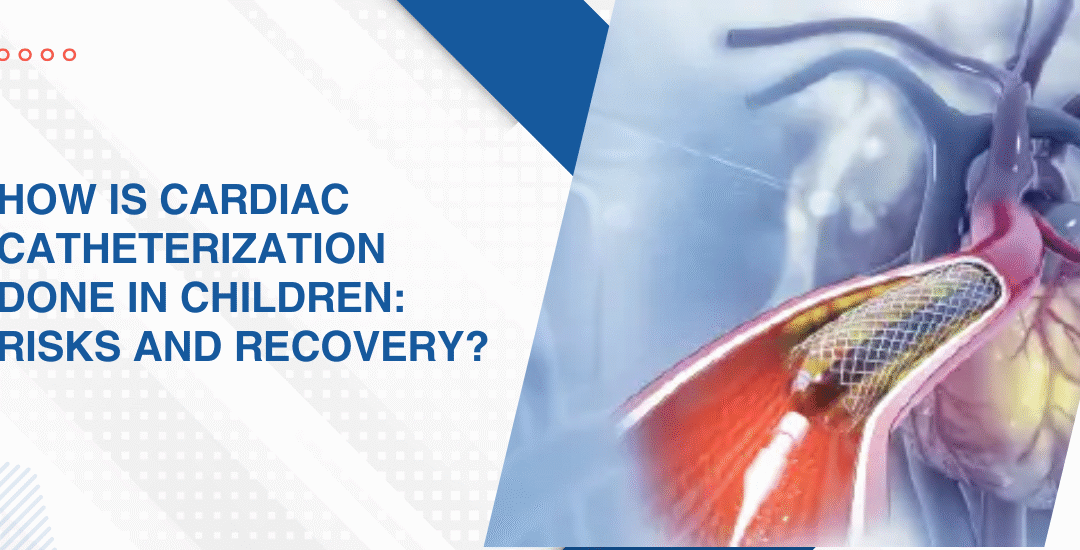
Cardiac catheterization in children is a minimally invasive and generally safe procedure performed under sedation or general anaesthesia, in which a thin tube called a catheter is guided through blood vessels into the heart for diagnosis or treatment. It usually allows faster recovery than surgery, with most children discharged within 24 hours, while the main risks involve minor bleeding or infection at the insertion site.
“Most parents hear the word catheterization and imagine something close to open heart surgery and the relief when I explain what it actually involves is something I see at almost every pre-procedure appointment. It’s a very different conversation to the one they were bracing for” says Dr. Prashant Bobhate, Pediatric Cardiologist in Mumbai, India.
How Is Cardiac Catheterization Actually Performed in Children?
Structured, precise and very different from the open surgical procedures most families confuse it with when they first hear the recommendation.
- Access site preparation: A needle punctures the femoral vein or artery in the groin under sterile conditions and a sheath is placed through which catheters of different sizes can be exchanged throughout the procedure without repeated punctures at the access site.
- Catheter navigation: The catheter is advanced through the vascular system into the right or left heart chambers under continuous fluoroscopic X-ray guidance and the operator steers it to specific locations inside the heart to take the measurements or perform the intervention the procedure was planned for.
- Pressure and oxygen measurements: In a diagnostic catheterization pressures in each cardiac chamber and the great vessels are recorded alongside oxygen saturations to calculate pulmonary vascular resistance, identify shunts and determine whether intervention is indicated and at what timing.
- Therapeutic interventions: In an interventional catheterization the same access allows balloon dilatation of a narrowed valve, deployment of a device to close an ASD or VSD, coil embolisation of an abnormal vessel or stenting of a narrowed pulmonary artery all without touching the chest wall.
Understanding the full range of what catheter-based procedures can achieve in children and when they are the right approach over surgery is exactly what a thorough interventional pediatric cardiology assessment maps out before any procedure date is set.
What Are the Risks and Recovery Like After Catheterization?
Not just for high-risk pregnancies, fetal echocardiography is important for any pregnancy where the anomaly scan raises a concern
- Abnormal anomaly scan: Any cardiac finding flagged on routine ultrasound including an asymmetric four-chamber view, an unusual cardiac axis or a suspected outflow tract abnormality is an immediate indication for fetal echo by a specialist who does this regularly not occasionally.
- Family history of CHD: A parent or sibling with a congenital heart defect increases the recurrence risk to 3 to 5 percent and that risk is high enough to warrant fetal echo in every pregnancy in that family regardless of what the routine scan shows.
- Maternal conditions: Diabetes, systemic lupus, phenylketonuria and certain autoimmune conditions are associated with specific fetal cardiac abnormalities and mothers with these conditions need fetal echo as a standard part of antenatal care not an optional add-on decided case by case.
- Fetal arrhythmia on Doppler: A sustained irregular fetal heart rhythm picked up on routine Doppler needs fetal echo to characterise whether it’s a benign ectopic beat pattern or a sustained arrhythmia that requires monitoring or treatment before delivery.
Parents wanting to understand what fetal echo can and cannot detect and how findings change management before birth should read this piece on can a fetal echo detect baby heart defects because understanding the scope of the investigation is what allows families to ask the right questions at the right appointment.
Why Choose Dr. Prashant Bobhate for Cardiac Catheterization in Mumbai?
A paediatric cardiac catheterization in the right hands is a precise, low-risk procedure that achieves things in an hour that would otherwise require open heart surgery and weeks of recovery. In less experienced hands the same procedure carries higher complication rates, longer procedure times and outcomes that don’t justify the risk. The operator matters as much as the indication. Dr. Prashant Bobhate has spent over 12 years performing diagnostic and interventional cardiac catheterizations across the full range of congenital defects including ASD and VSD device closure, balloon valvuloplasty, pulmonary artery stenting and India’s first transcatheter Potts shunt at the Children’s Heart Centre, Kokilaben Dhirubhai Ambani Hospital. Escorts Heart Institute New Delhi.
Schedule a consultation to find out if a cure is possible and what the right treatment plan looks like for you.
FAQs
Is cardiac catheterization painful for children?
No because it is performed under general anaesthesia and children feel nothing during the procedure and post-procedure discomfort at the groin access site is usually mild and managed easily with standard pain relief for a day or two.
How long does a cardiac catheterization take in a child?
A diagnostic catheterization takes roughly one to two hours while an interventional procedure like ASD closure or balloon valvuloplasty takes two to three hours depending on the complexity of the anatomy and how the procedure progresses.
Can a child go home the same day after cardiac catheterization?
Yes in most uncomplicated cases children are discharged the same day or the following morning after a monitoring period and return to light normal activity within three to five days with groin site restrictions for one week.
What should parents watch for at home after cardiac catheterization?
Significant swelling, bleeding or bruising at the groin site, fever above 38 degrees, pallor, breathlessness or any return of the symptoms the child had before the procedure all need same day medical assessment without waiting.
References:
- Cardiac Catheterization, MedlinePlus, U.S. National Library of Medicine — https://medlineplus.gov/ency/article/003419.htm
Congenital Heart Defects, National Heart Lung and Blood Institute — https://www.nhlbi.nih.gov/health/congenital-heart-defects