
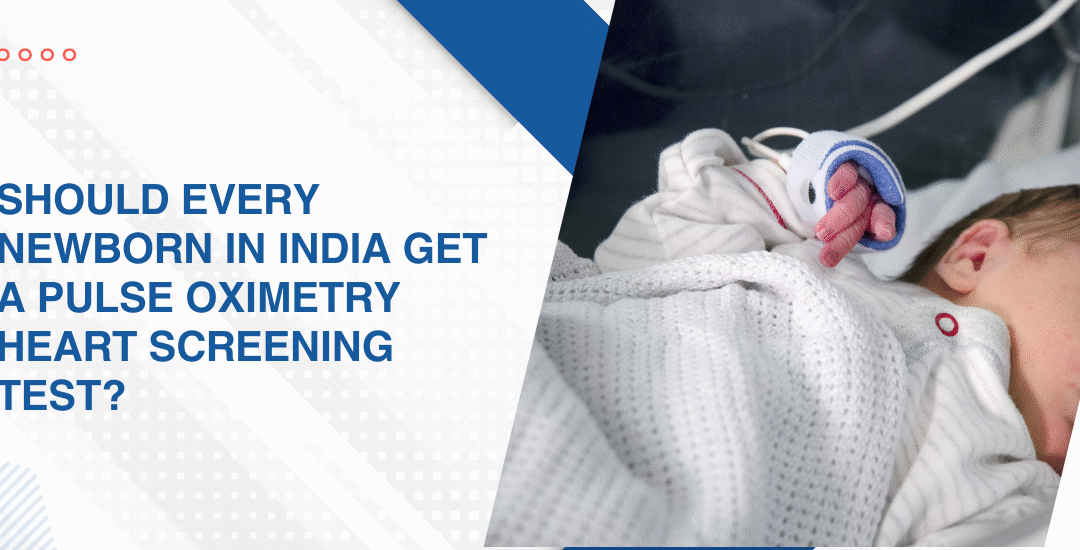
Yes, pulse oximetry screening is strongly recommended for all newborns, ideally after 24 hours of birth, to help detect critical congenital heart disease (CCHD). It is a safe, quick, and painless test that measures blood oxygen levels and can identify serious heart conditions that may be missed during physical examination or ultrasound..
“A baby can look entirely pink, feed well and pass every routine newborn check and still be carrying a critical heart defect that a pulse oximeter on the right hand and foot would have flagged in three minutes. The examination tells you the baby looks well. The oximeter tells you what the circulation is actually doing,” says Dr. Prashant Bobhate, Pediatric Cardiologist in Mumbai, India.
Why Is Pulse Oximetry Screening So Important for Newborns?
Because the defects it catches are the ones that kill babies at home in the first week of life when families have no idea anything is wrong.
- Critical CHD often looks normal: Conditions like transposition of the great arteries, pulmonary atresia, hypoplastic left heart and total anomalous pulmonary venous drainage can produce no visible cyanosis, no audible murmur and no feeding difficulty in the first 24 to 48 hours while the ductus arteriosus remains open and maintains circulation.
- The ductus closes: When the ductus arteriosus closes normally in the first few days of life a baby with a ductal-dependent defect who was discharged looking fine can deteriorate within hours to a state of circulatory collapse that is far harder to reverse than the original defect would have been to manage with planned intervention.
- Oximetry catches what eyes miss: A pre-ductal reading from the right hand and a post-ductal reading from either foot together create a differential saturation pattern that is specific enough to flag critical CHD in babies who look completely normal on every other parameter the newborn team assessed.
- Simple and scalable: Unlike fetal echo or echocardiography which require equipment and trained operators pulse oximetry screening needs only a pulse oximeter and a trained nurse and that simplicity is exactly what makes it feasible as a universal screening tool across every level of the Indian healthcare system from tertiary hospitals to district facilities.
Every newborn flagged on pulse oximetry screening needs immediate specialist assessment and congenital heart disease evaluation maps the anatomy and haemodynamic urgency before any management decision gets made.
Why Isn't Pulse Oximetry Screening Universal in India Yet?
Despite its proven value, pulse oximetry screening has not yet become a universal part of newborn care across India for several practical and systemic reasons
- Awareness gap: Many hospitals and maternity units in India are not yet routinely performing pre-discharge pulse oximetry screening because the clinical recommendation hasn’t been uniformly embedded into standard newborn care protocols across public and private facilities the way it has in higher income countries.
- False positive anxiety: A positive screen triggers an echo referral and in centres without immediate paediatric cardiology access that referral pathway isn’t always clear and the anxiety a positive screen generates in a family before the defect is confirmed or ruled out is something units without a clear protocol genuinely struggle to manage well.
- Equipment availability: While pulse oximeters are cheap and widely available the specific protocol requiring simultaneous pre and post ductal readings with defined saturation thresholds and repeat testing windows isn’t consistently followed even in facilities that own the equipment and consider themselves to be screening.
- No national mandate: Unlike several other newborn screening tests pulse oximetry for critical CHD detection is not yet mandated under India’s national newborn screening programme and without that mandate implementation remains inconsistent and dependent on individual hospital policy rather than a system-wide standard families can count on.
Parents wanting to understand what happens when critical congenital heart defects go undetected should also read about the early signs of heart disease in neonates and why early intervention matters.
Why Choose Dr. Prashant Bobhate for Newborn Cardiac Assessment in Mumbai?
A positive pulse oximetry screen in a newborn is not a diagnosis. It’s a flag that means a paediatric cardiologist needs to look at that heart the same day with an echocardiogram and decide what it’s showing and what needs to happen next before the ductus closes and the window closes with it. Dr. Prashant Bobhate has spent over 12 years managing neonatal cardiac emergencies, critical congenital heart defects and the urgent assessment pathway that begins with an abnormal pulse oximetry screen and ends with a clear management plan at the Children’s Heart Centre, Kokilaben Dhirubhai Ambani Hospital. Escorts Heart Institute New Delhi. Fellowship at University of Alberta Canada
Schedule a consultation to find out if a cure is possible and what the right treatment plan looks like for you.
FAQs
What is a normal pulse oximetry reading in a newborn?
A saturation of 95 percent or above in both the right hand and either foot with a difference of no more than 3 percent between the two readings is considered a passing screen and below these thresholds warrants repeat testing and cardiology referral.
Can pulse oximetry miss congenital heart defects?
Yes because it detects oxygen desaturation and some critical defects including certain forms of obstructed left heart disease maintain normal saturations while still being haemodynamically dangerous which is why a normal screen doesn’t fully replace clinical examination and parental vigilance at home.
When should pulse oximetry screening be done in a newborn?
Between 24 and 48 hours after birth is the recommended window because screening before 24 hours increases false positive rates from normal transitional circulation while waiting beyond 48 hours risks missing ductal-dependent defects before early discharge.
What happens if a newborn fails pulse oximetry screening?
A failed screen triggers immediate echocardiography by a paediatric cardiologist to confirm or exclude structural cardiac disease and if a critical defect is identified the neonatal and cardiac teams plan urgent intervention before the ductus arteriosus closes and haemodynamic stability is lost.
References:
- Congenital Heart Defects, MedlinePlus, U.S. National Library of Medicine — https://medlineplus.gov/congenitalheartdefects.html
- Pulse Oximetry Screening for Critical CHD, National Heart Lung and Blood Institute — https://www.nhlbi.nih.gov/health/congenital-heart-defects